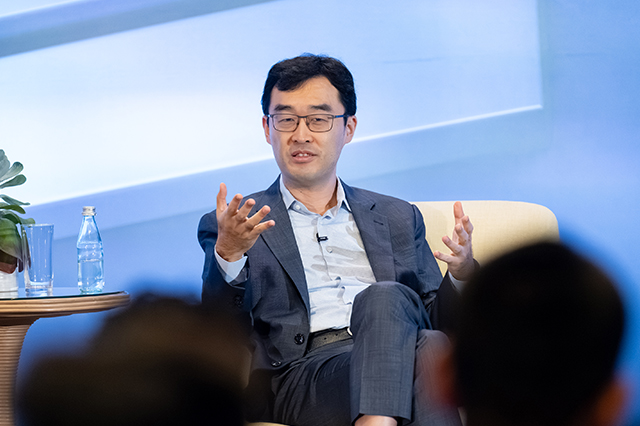
Ryan is a Quantitative Development Intern on Citadel Securities’ Low Latency Options team. His summer project centers on research related to passive quoting mechanics in the firm’s equity options business.
Ryan’s day often starts with a question about one of the mechanics behind the team’s passive quotes. Because those quotes influence how the team provides liquidity, small differences in their behavior add up quickly. Ryan digs into the data, investigates possible explanations and tests different ideas about where there may be an opportunity to improve.
Citadel Securities provides continuous liquidity across more than a million options series, so research into quoting mechanics can have a big impact that extends far beyond any single product.
Ryan’s work rarely begins with a predetermined answer or even a narrowly defined problem. Part of the challenge is figuring out which questions are worth pursuing in the first place.
“The problems we’re solving are very abstract, and we don’t know what the end goal is,” he says. “The most interesting part of my day is finding out how we get from point A to those unknown points.”
Finding the problem
Ryan’s projects often begin with a broad business question rather than a prescribed technical task.
He may start with a key performance indicator, investigate the factors influencing it and determine which underlying problem is most worth pursuing. That can involve exploring several hypotheses before the direction of the research becomes apparent.
“The problems in this space are very open-ended,” Ryan says. “Oftentimes, we’re looking for problems first and then solutions to them.”
Because the research is nonlinear, it’s up to Ryan to decide what evidence is relevant, which questions deserve another round of testing and when he has learned enough to narrow the search.
For him, exploring that uncertainty is part of what makes his workday interesting. Defining the problem is most of the work; solving it comes afterward.
Building a rigorous process
Working through that ambiguity has changed how Ryan judges his own work.
A clear approach lets him form a hypothesis, test it, explain what he found and iterate when the evidence points elsewhere. It also makes it easier for colleagues to understand his reasoning, challenge assumptions and build on the work.
“The biggest thing that I’ve learned in this internship is that your process matters more than anything,” he says, “and that good results are simply an artifact of a great process.”
His manager, Pranal, has helped him refine that process over the summer, particularly when the research space is broad. Rather than giving Ryan a fixed sequence of steps, the team gives him room to pursue different ideas, validate them and return with findings or new questions.
Therefore, much of the responsibility for navigating the research sits with Ryan.
Closing the loop
As the summer progresses, check-ins become less frequent because Ryan carries his own ideas further before requesting a second opinion.
Large language models are an important tool in that workflow. According to Pranal, they let interns explore a wider range of ideas and test findings more independently.
“He’s able to close the loop by himself much more,” Pranal says, “which allows him to become more efficient and test more findings himself and validate those before coming back to the team.”
The tools can help Ryan move through that cycle faster, but the core decisions—like what to investigate, how to interpret what he finds and which questions merit further work—remain his.
“As an intern, Ryan still gets the same responsibility as if he were a full-time employee,” Pranal says.
Learning with the team
On the Low Latency Options team, that work happens out loud. Colleagues share charts and ideas, compare approaches and pull one another into conversations when their research overlaps.
“The team culture is incredibly open and collaborative,” Ryan says. “We will oftentimes bounce charts and images back and forth on each other’s screens and chat with each other throughout the day about the various problems that we’re solving.”
Working that closely gives Ryan frequent opportunities to test his thinking against colleagues who are exploring related questions from different angles. It also helps the team avoid duplicating work when research areas intersect.
The camaraderie extends outside the office as well. Ryan says the team spends time together over dinner and on the tennis and padel courts.
Taking ownership
Ryan finds the connection between his research and the business it supports particularly rewarding. His project feeds into the team’s equity options quoting process, so a finding that holds up shows up in more places.
“The ability as an intern to have such a large impact on such a large distributed system is honestly incredible,” he says.
It’s also shaped the advice he would give future interns: Ask genuine questions about the core business, stay proactive and recognize that there’s almost always another useful avenue to explore.
Pranal hopes Ryan leaves the summer with “a passion and curiosity for solving harder problems.”
It sounds like Ryan is well on his way.