Emily’s day usually started with a pricing question without an obvious answer. Markets move throughout the day, and those moves can influence how an option’s volatility behaves. Her job was to study those changes to determine how the team’s existing model could respond more effectively.
Emily was a Quantitative Trading Intern on Citadel Securities’ FICC Options team. Her summer project entailed improving an existing options pricing model by incorporating more intraday information about how markets change.
The model looks at the relationship between movements in an underlying market and changes in an option’s volatility curve. She explored how information arriving throughout the trading day could help the model reflect those relationships more accurately.
“What my project is doing is taking intraday information, like when markets are changing dynamically throughout the day, and being able to reflect these small changes into our existing model so that we can make better and more informed trades,” she said.
For Emily, part of the appeal was seeing how an improvement could move from an idea into the systems traders use.
“One thing I really like about this project is that I can directly see how this would be put into production,” she said.
Working through a complex pricing problem
Emily’s project began as a broad, difficult research question, which her manager, Jack, deemed one of the team’s more complex pricing problems.
Traditional models don’t always fully explain how markets respond to fast-moving signals, so Emily studied those differences to improve the team’s approach to option pricing. Better pricing lets the team offer more competitive prices to clients and be a more competitive market maker.
At the beginning of the summer, Emily was much more intimidated by the project.
“When I first started on my project, I think it felt really overwhelming because I could tell that there were a lot of moving parts,” she said.
So Jack helped her break the problem into smaller questions she could test one at a time.
Turning complexity into a research process
After Jack offered that critical guidance, Emily took ownership of the research.
She formed ideas, tested them against the data and used what she learned to decide where to go next. Emily found direction in what was once an open-ended project via the evidence her research produced.
“I have the liberty to pursue my own ideas, try out my own ideas. And I also get the resources and support to bring these ideas out fully and watch them grow from ideas to becoming a tangible product,” she said.
Emily’s research was also influenced by the scale and frequency of the data her team could access. Quantitative traders can zero in on patterns across markets and asset classes at a level of detail that opens up questions that would be difficult to study otherwise.
The same iterative approach showed up in Emily’s broader training. Trading exercises, for instance, force interns to make decisions with incomplete information.
“They often put you in situations where you don’t have a lot of information, and you have to take risks in order to both do well but also gain more information,” Emily said.
Learning how to make a reasonable decision amid uncertainty, then updating it as new information arrives, became one of the most useful lessons of the summer.
Pressure-testing the work
Emily’s ideas were tested constantly.
She spoke with other traders to learn how they used the team’s systems and how her model could fit into their day-to-day work. She also received feedback from people across the team, from colleagues early in their careers to senior leaders on the desk.
Jack said the team stress-tested the work as the project developed.
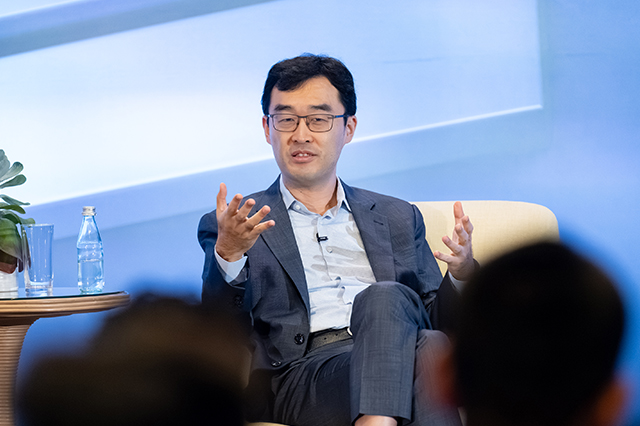
“We apply a lot of rigor, a lot of testing, a lot of reviews of the different numbers and the plots and the methodology that she has,” he said.
For Emily, those conversations provided context she couldn’t glean from the data alone.
“My team has been incredibly encouraging and welcoming throughout my whole internship,” she said. “Whenever I have a problem, if I’m a little lost, I always have people that I can directly go to.”
From research to something the desk can use
As the summer progressed, Emily’s project moved closer to the desk.
Talking with experienced traders helped her understand whether a model worked statistically and if the result would be useful in practice.
“I can directly see how what I’m doing is able to become something that would be actually useful to them,” she said. “And I think I’m very proud of that.”
Trusted with real responsibility
According to Jack, her project was typical of the work a quantitative trader does as a full-time team member. She worked on a real pricing problem, drove much of the research and was held accountable for the quality of the result.
“I really appreciate how much responsibility and trust we as interns are given,” Emily said. “The other traders on my team really respect and are truly listening to the ideas that I bring to the table.”
That experience shaped the advice she’d give prospective interns: Take ownership of the work and produce something you’d be proud to put your name on.
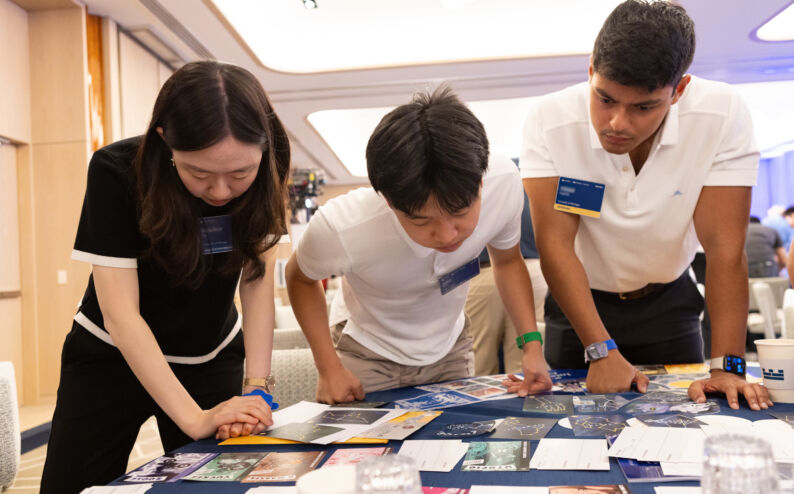
Emily particularly liked that the intern community is tight-knit, with people comparing projects and sharing ideas across teams. Hearing how other interns approached very different problems gave her insight into the work happening around her.
A day with Emily showed how those pieces fit together. She might start with a market relationship that was difficult to explain, break it down into something she could test, present the evidence to the rest of the desk for a challenge and return to the model with a sharper view. Because the market kept changing, the answer was rarely final. What carried from one question to the next was the process: learn quickly, test rigorously and keep refining until the research becomes something the desk can use.
Emily will be joining the team full-time next year.