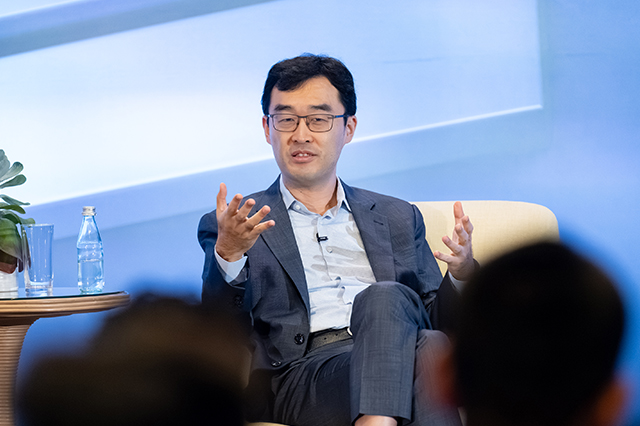
A typical day for Sriram might begin with a question about where the desk is quoting too much or too little across a wide universe of options. From there, he may move into the data, test whether a proposed change holds across different products and then compare his findings with the trading activity unfolding around him.
Sriram is a Quantitative Trading Intern in Citadel Securities’ Miami office, working with the Systematic Equity Options team. His summer project focuses on quote sizing, i.e., how the desk determines the appropriate quote size to show across the products it trades. The work is closely connected to the desk’s core responsibility of providing liquidity efficiently and consistently.
At the scale of the business, even a small improvement can matter. The team trades hundreds of thousands, sometimes millions, of contracts each day. A change that improves how quotes are calibrated can be applied across tens of thousands of products and millions of options.
“The most exciting part of my day-to-day is definitely the project work that I get to do,” Sriram says. “They want you to have real impact as an intern.”
Understanding the problem
One of Sriram’s projects might begin with a practical trading question: Where should the desk quote more size, and where should it quote less?
Answering it requires Sriram to understand how different parameters affect the desk’s behavior across products, how those products differ and whether a proposed change would improve the strategy when applied systematically.
His manager, Christian, describes the assignment as questioning the existing parameters from the ground up and developing models that can improve them across a large, varied trading universe. The strategies can be calibrated in fine detail. Each adjustment may be small on its own, but it has to hold up reliably across the whole trading universe.
“If I’m able to find some actionable changes in our quoting strategy, it can be applied to the entire universe of symbols that we trade,” he says. “That is very exciting.”
Working at scale
Sriram’s approach depends upon the scale of the problem he’s trying to solve.
The team sends billions of quotes to exchanges each day, generating large volumes of data to be studied for patterns and opportunities. Making sense of such massive data troves requires sharp trading intuition as well as the technical skill to build clean, reliable data pipelines.
A model may look promising in one slice of the data, but it can behave differently across products, market conditions or strategy settings. So Sriram breaks the problem into smaller pieces, tests his assumptions carefully and checks how they fit together before recommending a broader change.
Christian emphasizes why this structure is so important. At the scale the desk operates, an unclear approach to data or decision-making can quickly create inefficiency. A clear framework lets the team break a large, complicated question down into a series of smaller tasks it can test and refine.
Connecting research to live trading
The feedback loop between his project and the live market is immediate.
Sriram can analyze a pattern in the data, discuss it with traders and then see related trading activity on the desk. Those observations can feed back into his project, helping him refine the model and make the analysis more robust.
“There’s an immediate feedback loop between the project and the real-world trading taking place in our office every day,” Christian says.
Being close to the desk gives Sriram context the data alone would not. A series of trades may reveal why the desk normally handles a situation in a particular way, or why a theoretically appealing change may need to be adjusted before it can work in practice.
The influence runs both ways: The desk shapes the project, and the project surfaces insights the desk uses to rethink its systems.
Learning from the desk
Although Sriram owns his project work, he’s surrounded by people who use different approaches to the same problems.
He regularly asks traders how they would think through a question, shadows colleagues and compares the perspectives he receives. Working alongside so many extraordinary colleagues has taught Sriram that a trading problem can be framed in many different ways.
“One of the best aspects of this culture is that it’s possible to ask pretty much anyone on the desk about their approach to whatever problem you might be having,” he says. “They often give unique insights that you might not otherwise have thought of.”
Sriram is encouraged to take initiative, bring forward his own thinking and use feedback to sharpen it. He can’t just wait for someone to hand him the answer.
Owning his project while having that kind of access makes feedback a central component of his summer internship. Sriram describes his colleagues as eager to engage when he asks for help, while still expecting him to be meticulous and organized in his approach.
Building a decision-making framework
Beyond the project itself, Sriram says the internship has changed his perspective on how he makes decisions.
The program pushes interns to independently structure problems, weigh the evidence and work out where they can add the most value. For Christian, that discipline is one of the most important skills an intern can develop on the desk.
“We spend a lot of time focusing on the smallest building blocks,” Christian says. “By being able to put them together, you can tackle very large problems.”
The same approach guides his workday. He may start with a broad question about quote sizing, separate it into specific parameters, test those pieces across a large trading universe and then bring the findings back to the desk for challenge and refinement.
The problem is large, but the method is consistent: Build a clear framework, examine each assumption and keep refining the answer as new evidence arrives.
Asked what advice he would give a future intern, Sriram returns to the same habits that have shaped his own summer.
“Always take initiative in your project work and your feedback,” he says. “Be open to asking for feedback, and be extremely meticulous and organized.”
His days reflect that balance. The work moves between models and markets, between independent analysis and conversations with experienced traders. The goal stays the same throughout: Turn a complex trading problem into a structured decision, then make it useful at scale.