
A foundational view of the technology platform, the engineering problems it creates and where different engineering roles contribute.
Markets are shaped by data, quantitative models, automation and real-time infrastructure. The systems at their core must process changing information, maintain rapidly evolving state, communicate across global venues and remain accurate and resilient while markets move. These demands make modern market making a large-scale engineering problem.
At Citadel Securities, engineering operates within that framework. Engineers build the infrastructure that lets researchers test ideas, traders express strategies, market and client workflows reach venues and the broader platform operate as products, markets and technologies change.
For a candidate, the technical draw is the mix of familiar computer-science disciplines applied within a live environment where the inputs, constraints and requirements are always in flux.
Some work runs deep in distributed systems, handling real-time state and failure recovery. Other work builds the cloud and compute systems that change what quantitative researchers can test. Engineers can work on networking and low-latency software where their design is shaped by how markets communicate. And applications serve users tasked with making decisions amid constantly changing information.
Although these problems are distinct, they share a single broader system. Engineers understand how a component works, what it enables and which constraints matter to the people and systems that depend on it.
It’s helpful to think of the platform as several connected technical environments supported by shared engineering foundations.
A foundational view of the technology platform, the engineering problems it creates and where different engineering roles contribute.
Markets are shaped by data, quantitative models, automation and real-time infrastructure. The systems at their core must process changing information, maintain rapidly evolving state, communicate across global venues and remain accurate and resilient while markets move. These demands make modern market making a large-scale engineering problem.
At Citadel Securities, engineering operates within that framework. Engineers build the infrastructure that lets researchers test ideas, traders express strategies, market and client workflows reach venues and the broader platform operate as products, markets and technologies change.
For a candidate, the technical draw is the mix of familiar computer-science disciplines applied within a live environment where the inputs, constraints and requirements are always in flux.
Some work runs deep in distributed systems, handling real-time state and failure recovery. Other work builds the cloud and compute systems that change what quantitative researchers can test. Engineers can work on networking and low-latency software where their design is shaped by how markets communicate. And applications serve users tasked with making decisions amid constantly changing information.
Although these problems are distinct, they share a single broader system. Engineers understand how a component works, what it enables and which constraints matter to the people and systems that depend on it.
It’s helpful to think of the platform as several connected technical environments supported by shared engineering foundations.
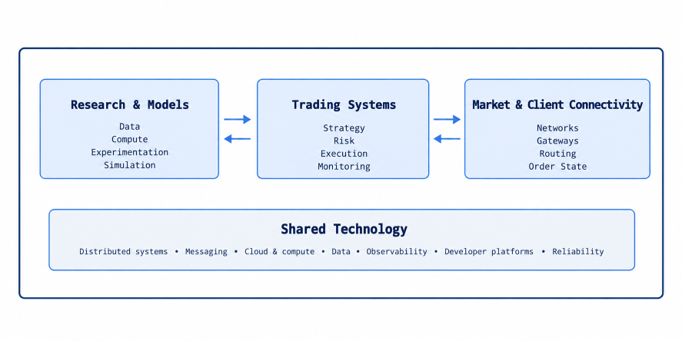
Quantitative research depends on large, heterogeneous datasets; computational experiments; simulation and the ability to repeatedly compare results. The engineering problem extends beyond supplying compute because researchers need reliable abstractions for data access, workload orchestration, reproducibility, accelerator use and movement between exploration and production-like environments.
A researcher may need to rerun a model across years of market data with a new feature set. Data must be partitioned and moved efficiently, large jobs need scheduling and recovery, run metadata must preserve enough context to compare experiments and the infrastructure should hide mechanics well enough so the researcher can focus on the question. Progress depends less on how much compute exists and more on how effectively the platform converts it into credible research.
Trading systems take models, strategy logic, market information and risk inputs and render them as production behavior. That can require real-time state management, pricing and risk calculations, execution logic and controls, and message sequencing and monitoring while the strategy operates.
Suppose a strategy receives market data, risk inputs and execution updates from different services. If a process restarts or a message is delayed, every consumer still needs a consistent view of what happened. One architectural response is to make transitions explicit and replayable so recovery reconstructs the same history instead of relying on mutable state that may already have moved on. The engineering difficulty lies in sustaining that performance while keeping system state coherent.
Orders and information must also move between the platform and the outside world, creating engineering problems in networking, gateways, order management, routing, execution, reporting and real-time analytics. Although different venues expose different protocols and behaviors, the internal system still needs a reliable representation of the order lifecycle.
An order can cross a network edge, gateway, routing logic and execution system before its final state is reported. If a connection or process fails mid-flight, the platform must recover without duplicating the request, losing a transition or reporting an inconsistent result. That pushes identifiers and sequencing, idempotency and reconciliation, redundancy and monitoring into the same design problem.
Beneath these environments sit capabilities used across the platform, including distributed messaging, data, cloud and compute, deployment infrastructure, observability, developer tooling and reliability engineering. Part of their value comes from relieving other teams of the burden of building solutions themselves.
For example, a strategy team shouldn’t have to invent a messaging system every time it needs reliable state distribution. And a research team shouldn’t be expected to manage the underlying compute fleet to launch an experiment. Shared engineering concentrates expertise and packages common technical problems as platforms other teams can build on.
There’s no single engineering constraint called “markets.” A latency-sensitive execution path, research platform, client workflow and monitoring system optimize for different combinations of response time, throughput, correctness, resilience, flexibility and observability.
A low-latency network path may be ideal for one workload and wrong for another that experiences large correlated bursts and values completeness and capacity more than the smallest forwarding delay. A general-purpose server can simplify operations and still be a poor choice when one workload is bound by cache locality and another by dense compute or accelerator throughput.
The first engineering question is rarely “What is fastest?” It’s usually “What outcome does this workload need, and which constraint is actually binding?”
Technical architecture can’t always be separated from the market or research problem. A new capability may begin with a trading strategy, research requirement, market opportunity or an existing workflow that no longer scales. Engineers work with traders, quantitative researchers and other specialists to frame that objective as an explicit technical problem and figure out:
The answers to these questions shape the architecture. Engineers then continue through design, testing, deployment and production feedback, revisiting assumptions as the system meets real-world conditions. Defining the specification can be part of the engineering.
The firm has multiple centers of technical gravity because a single role can’t own every layer of the platform. These distinctions reflect the type of problem and its context; they don’t rank the work’s overall importance.
Software engineers work throughout the platform, spanning performance-critical distributed systems and market connectivity to research systems, cloud infrastructure, data platforms, real-time applications and developer tooling. The common discipline is systems and software engineering, which entails understanding the requirements, choosing an architecture, writing and testing code, and operating the technology other people and systems depend on.
Quantitative developers work where software engineering and quantitative problems closely overlap. Their work can include research infrastructure, simulation, strategy implementation, data pipelines, quantitative analytics and production trading systems. The role combines engineering depth with enough quantitative and market context to reason about what the system must accomplish.
Site reliability engineers are concerned with how critical systems behave in production, focusing on reliability, observability, capacity, deployment, incident response, automation and failure recovery. In a market environment, that entails operating systems that hold rapidly changing state and interact continuously with trading and external markets.
FPGA engineers design and deploy programmable hardware for the most latency-sensitive parts of the platform, working across digital logic, networking and the C++ software that drives it. The discipline centers on hardware/software co-design, i.e., deciding which parts of a system belong in programmable logic, meeting exacting timing and determinism requirements and preserving the accuracy the rest of the system depends on.
User interface engineers build high-performance applications through which traders, clients and other users interact with real-time market, pricing, execution and analytics systems. The role combines frontend engineering with product judgment: making complex system behavior usable without hiding the critical information, while reasoning front to back about how state reaches the browser, where latency is introduced and what belongs in the client versus a service.
Technical domains that can cut across the aforementioned roles include low-latency engineering, cloud and compute, distributed messaging, research platforms, applications, data and infrastructure. An engineer can build deep expertise in one of them while working with specialists elsewhere in the system.
Specialization is what keeps every team from having to solve every technical problem. Platform specialists can go deep on messaging, compute, reliability or developer infrastructure. Meanwhile, engineers closer to a trading or research workflow can focus on the domain-specific problem while using those shared capabilities.
Much of the benefit comes from how specialists interact. A reliability improvement can become a common platform capability, or a better approach to distributed state can mitigate complexity in myriad applications. Improving a research platform can expand the set of experiments researchers can practically run. In practice, that interaction is part of the firm’s collaborative culture: the fastest way to understand an unfamiliar constraint is often to ask the person who’s spent years working within it.
Specialized engineering isn’t eliminated; it’s concentrated where a common solution creates leverage and preserved where the workload genuinely requires it.
Growth here is determined by the ambiguity and scope of the problems an engineer takes on, not by seniority. Early work may begin with a defined component. Over time, the problems become more abstract and could entail understanding what’s limiting a system, choosing among architectural approaches, deciding whether a local fix or a shared capability is appropriate and determining what should be built next.
A well-formed idea can come from someone in their first year as readily as someone whose tenure spans decades. What counts is whether the reasoning holds. Any engineer who can frame their problem clearly and demonstrate why their approach is right can be given the people and resources to pursue it. Advancement depends more on good judgment than tenure.
The most critical judgment skills go beyond testing. Although performance and scale testing can show how a system behaves, the important part is stepping back, thinking critically, and asking what will actually happen and what could make the system fail.
Markets, research methods and technology keep changing, so there’s no final architecture. The engineering opportunity lies within that evolution by solving difficult technical problems, understanding the system context around them and building capabilities that can continually adapt as requirements move.
That constant state of flux is part of the appeal. Working in an industry at a genuinely transformative moment is a rare opportunity. What’s even more uncommon is finding somewhere with the foundation and context in place to enact tangible change.
Though the systems differ in their demands, the engineering behind them is continuous.
Quantitative research depends on large, heterogeneous datasets; computational experiments; simulation and the ability to repeatedly compare results. The engineering problem extends beyond supplying compute because researchers need reliable abstractions for data access, workload orchestration, reproducibility, accelerator use and movement between exploration and production-like environments.
A researcher may need to rerun a model across years of market data with a new feature set. Data must be partitioned and moved efficiently, large jobs need scheduling and recovery, run metadata must preserve enough context to compare experiments and the infrastructure should hide mechanics well enough so the researcher can focus on the question. Progress depends less on how much compute exists and more on how effectively the platform converts it into credible research.
Trading systems take models, strategy logic, market information and risk inputs and render them as production behavior. That can require real-time state management, pricing and risk calculations, execution logic and controls, and message sequencing and monitoring while the strategy operates.
Suppose a strategy receives market data, risk inputs and execution updates from different services. If a process restarts or a message is delayed, every consumer still needs a consistent view of what happened. One architectural response is to make transitions explicit and replayable so recovery reconstructs the same history instead of relying on mutable state that may already have moved on. The engineering difficulty lies in sustaining that performance while keeping system state coherent.
Orders and information must also move between the platform and the outside world, creating engineering problems in networking, gateways, order management, routing, execution, reporting and real-time analytics. Although different venues expose different protocols and behaviors, the internal system still needs a reliable representation of the order lifecycle.
An order can cross a network edge, gateway, routing logic and execution system before its final state is reported. If a connection or process fails mid-flight, the platform must recover without duplicating the request, losing a transition or reporting an inconsistent result. That pushes identifiers and sequencing, idempotency and reconciliation, redundancy and monitoring into the same design problem.
Beneath these environments sit capabilities used across the platform, including distributed messaging, data, cloud and compute, deployment infrastructure, observability, developer tooling and reliability engineering. Part of their value comes from relieving other teams of the burden of building solutions themselves.
For example, a strategy team shouldn’t have to invent a messaging system every time it needs reliable state distribution. And a research team shouldn’t be expected to manage the underlying compute fleet to launch an experiment. Shared engineering concentrates expertise and packages common technical problems as platforms other teams can build on.
There’s no single engineering constraint called “markets.” A latency-sensitive execution path, research platform, client workflow and monitoring system optimize for different combinations of response time, throughput, correctness, resilience, flexibility and observability.
A low-latency network path may be ideal for one workload and wrong for another that experiences large correlated bursts and values completeness and capacity more than the smallest forwarding delay. A general-purpose server can simplify operations and still be a poor choice when one workload is bound by cache locality and another by dense compute or accelerator throughput.
The first engineering question is rarely “What is fastest?” It’s usually “What outcome does this workload need, and which constraint is actually binding?”
Technical architecture can’t always be separated from the market or research problem. A new capability may begin with a trading strategy, research requirement, market opportunity or an existing workflow that no longer scales. Engineers work with traders, quantitative researchers and other specialists to frame that objective as an explicit technical problem and figure out:
The answers to these questions shape the architecture. Engineers then continue through design, testing, deployment and production feedback, revisiting assumptions as the system meets real-world conditions. Defining the specification can be part of the engineering.
The firm has multiple centers of technical gravity because a single role can’t own every layer of the platform. These distinctions reflect the type of problem and its context; they don’t rank the work’s overall importance.
Software engineers work throughout the platform, spanning performance-critical distributed systems and market connectivity to research systems, cloud infrastructure, data platforms, real-time applications and developer tooling. The common discipline is systems and software engineering, which entails understanding the requirements, choosing an architecture, writing and testing code, and operating the technology other people and systems depend on.
Quantitative developers work where software engineering and quantitative problems closely overlap. Their work can include research infrastructure, simulation, strategy implementation, data pipelines, quantitative analytics and production trading systems. The role combines engineering depth with enough quantitative and market context to reason about what the system must accomplish.
Site reliability engineers are concerned with how critical systems behave in production, focusing on reliability, observability, capacity, deployment, incident response, automation and failure recovery. In a market environment, that entails operating systems that hold rapidly changing state and interact continuously with trading and external markets.
FPGA engineers design and deploy programmable hardware for the most latency-sensitive parts of the platform, working across digital logic, networking and the C++ software that drives it. The discipline centers on hardware/software co-design, i.e., deciding which parts of a system belong in programmable logic, meeting exacting timing and determinism requirements and preserving the accuracy the rest of the system depends on.
User interface engineers build high-performance applications through which traders, clients and other users interact with real-time market, pricing, execution and analytics systems. The role combines frontend engineering with product judgment: making complex system behavior usable without hiding the critical information, while reasoning front to back about how state reaches the browser, where latency is introduced and what belongs in the client versus a service.
Technical domains that can cut across the aforementioned roles include low-latency engineering, cloud and compute, distributed messaging, research platforms, applications, data and infrastructure. An engineer can build deep expertise in one of them while working with specialists elsewhere in the system.
Specialization is what keeps every team from having to solve every technical problem. Platform specialists can go deep on messaging, compute, reliability or developer infrastructure. Meanwhile, engineers closer to a trading or research workflow can focus on the domain-specific problem while using those shared capabilities.
Much of the benefit comes from how specialists interact. A reliability improvement can become a common platform capability, or a better approach to distributed state can mitigate complexity in myriad applications. Improving a research platform can expand the set of experiments researchers can practically run. In practice, that interaction is part of the firm’s collaborative culture: the fastest way to understand an unfamiliar constraint is often to ask the person who’s spent years working within it.
Specialized engineering isn’t eliminated; it’s concentrated where a common solution creates leverage and preserved where the workload genuinely requires it.
Growth here is determined by the ambiguity and scope of the problems an engineer takes on, not by seniority. Early work may begin with a defined component. Over time, the problems become more abstract and could entail understanding what’s limiting a system, choosing among architectural approaches, deciding whether a local fix or a shared capability is appropriate and determining what should be built next.
A well-formed idea can come from someone in their first year as readily as someone whose tenure spans decades. What counts is whether the reasoning holds. Any engineer who can frame their problem clearly and demonstrate why their approach is right can be given the people and resources to pursue it. Advancement depends more on good judgment than tenure.
The most critical judgment skills go beyond testing. Although performance and scale testing can show how a system behaves, the important part is stepping back, thinking critically, and asking what will actually happen and what could make the system fail.
Markets, research methods and technology keep changing, so there’s no final architecture. The engineering opportunity lies within that evolution by solving difficult technical problems, understanding the system context around them and building capabilities that can continually adapt as requirements move.
That constant state of flux is part of the appeal. Working in an industry at a genuinely transformative moment is a rare opportunity. What’s even more uncommon is finding somewhere with the foundation and context in place to enact tangible change.
Though the systems differ in their demands, the engineering behind them is continuous.


