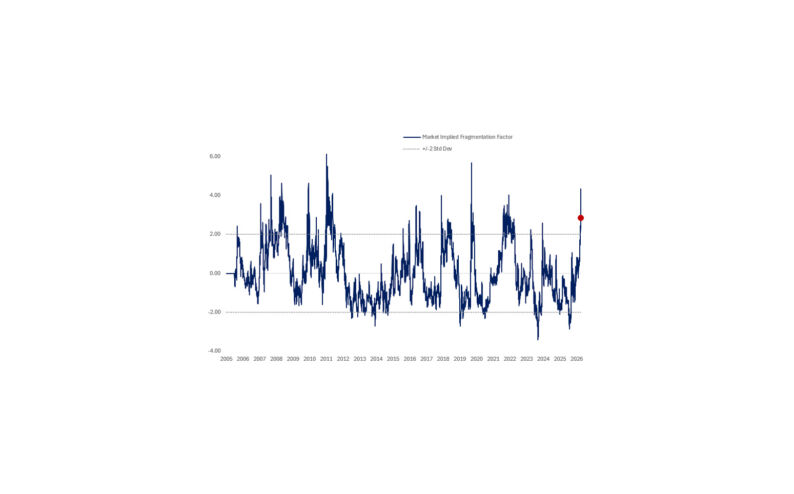
We have for some time argued that inflation risks were tilted to the upside, that the labor market was no longer a source of downside risk to the economy, and that the Fed staff and speakers were moving in a more hawkish direction. Ahead of the June meeting, we published an expectation of rate hikes in September and December. The tone of the June meeting was consistent with our significantly more hawkish-than-consensus outlook, with Chair Warsh repeatedly emphasizing price stability and implying that the Fed is willing to act against the one-sided risks to its mandate. Our risk assessment was based on a simple exercise: benchmarking the changes in the key SEP forecasts that we expected, namely a downward revision to the unemployment rate, small downward revisions to GDP growth, and substantial upward revisions to the 2026 and 2027 inflation forecasts, then feeding those updated forecasts into a range of Taylor rule specifications. The result was an unambiguously hawkish shift in the model-implied policy prescription, which seemed impossible to square with anything other than a clear risk of imminent rate hikes, especially when set against the tone of Chair Warsh’s speeches over the past 25 years, which have repeatedly emphasized inflation risks. We subsequently noted the relevance of the market unwinding the newfound credibility premium in the weeks following the June FOMC meeting and that this raised the risks of a July hike, although at the time we stopped short of making it our modal scenario. We think the market may once again be underestimating the extent of the hawkish shift at the Fed, and that the (for now) moderate increase in energy prices may tip an already finely balanced meeting in favor of a hike this week.
From a tactical perspective, there appears to be more to gain for Chair Warsh from a July hike than from a September hike. Delivering a surprise hike in July would serve several purposes. It would emphatically end the forward guidance era in which every policy move is pre-signaled and act as a cleansing event, forcing markets to price what the data imply the central bank should do rather than what they expect it will do. It would also clearly underline Federal Reserve independence after two years in which it has been repeatedly questioned. Most importantly, however, a surprise rate hike can meaningfully alter the price-setting and wage-formation process because it demonstrates to firms and workers, through a willingness to accept some cost to economic activity, that the central bank will not tolerate inflation. This should temper both price-setting and wage demands before activity has materially slowed, meaning that the central bank ultimately must tighten less than it would under a more inertial reaction function. But to maximize the probability of changing the inflation process, the central bank must first deliver decisive policy action to jolt economic agents into internalizing a new reaction function. The July meeting is therefore particularly opportune: if Chair Warsh waits until September, he risks muting the impact because that timing would appear more consistent with the pervious, more inertial framework and, given current pricing, carry far less informational force.
In a rational-expectations and/or adaptive framework, the relevant shock is the information conveyed about the entire future path of policy, not simply the spot move in the policy rate. Crucially, because tightening imposes visible economic costs and tightening without forewarning carries inherent risk, the action has greater credibility than verbal guidance: the central bank is demonstrating, rather than merely asserting, its intolerance of inflation and is willing to pay a price to do so. The clear limitation is that a one-off surprise works through credibility only if markets believe it reveals a durable policy rule. If the central bank subsequently retreats, the initial tightening may have little persistent effect and could even damage credibility. The strongest effect comes when the hike causes price setters to revise not just their expectations for the next policy decision, but their beliefs about how systematically the central bank will respond to future inflation deviations. This raises the bar for talking hawkishly while keeping policy on hold, which is why we think the characterization of Warsh as merely performatively hawkish carries little weight – at least until we see the July decision.
Next, we turn to committee dynamics and whether Chair Warsh has the support to deliver a rate hike. We think the answer is straightforward: yes. The fact that markets are almost fully priced for a hike by September reflects the broad strength of the US economy, the recognition that inflation is moving in the wrong direction, and the risk that events in the Middle East generate further price pressure. Combined with the hawkish tilt in Fed speak, these factors make a September hike relatively uncontroversial in markets, and we suspect the same is true within the FOMC. If a majority of the FOMC is already likely to support a September hike, and if we are right that Warsh has much to gain by moving in July, it seems unlikely that voting members would oppose the Chair over acting six weeks earlier than they otherwise would, in the middle of an oil shock and with no perceived risk on the labor-market side of the mandate? The Chair is not omnipotent, but on a line-ball call like this, there is likely to be significant deference.
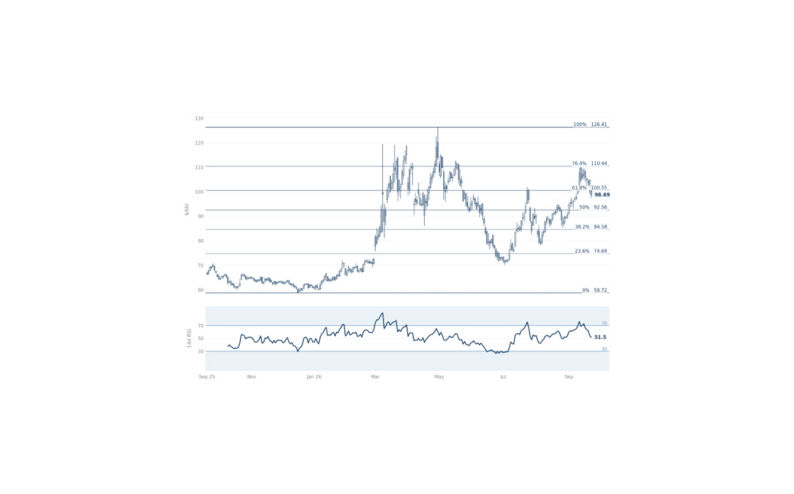
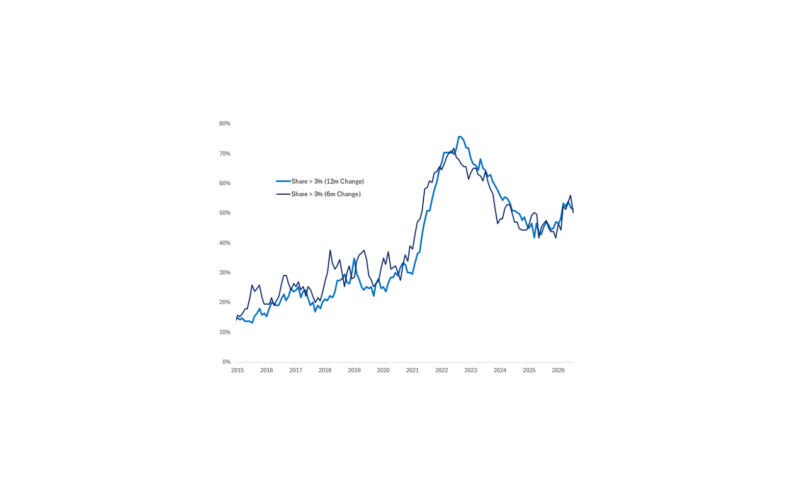
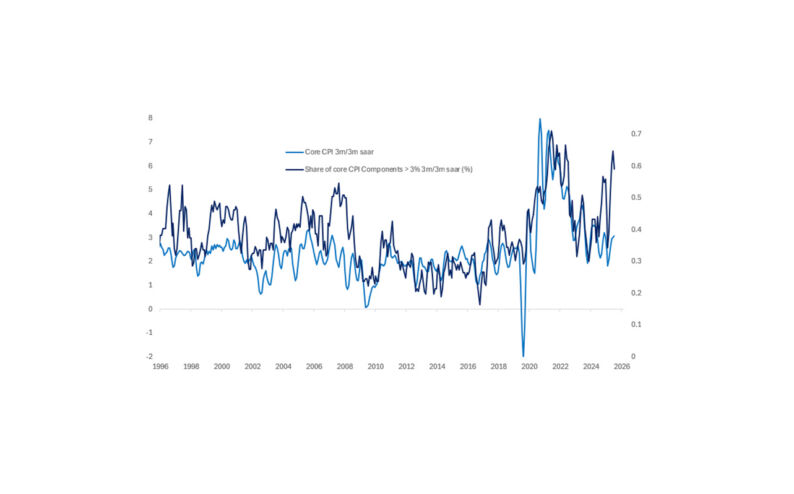
Markets became more relaxed about the prospect of a July hike following the weaker June payrolls report and a significant downside miss in the inflation data. Our first instinct was similar, especially given the breadth of the inflation miss. However we worry this may be a bad reflex from a foregone era. It appears that a meaningful share of the weakness in the June inflation print will reverse, that the next payroll report will be relatively strong, and that crude oil prices are now somewhat above their level at the June meeting. The re-escalation of the conflict in the Middle East serves as an important reminder of the volatility of the situation, and underlines the risks of monetary policy looking through an energy shock, by anchoring too much to an uncertain trajectory of geopolitical risk. More importantly – Chair Warsh specifically pushed back against treating a single month of data as mission accomplished and went to great lengths, both in testimony and at the June meeting, to argue that the Fed should move away from setting policy on the basis of the latest data point. This seems reasonable, particularly after more than five years of core CPI above 2.5%.
Finally, we think it is important to recognize that July is ultimately a call about central-banking tactics and signaling rather than an exercise in counting votes or analyzing a single inflation or jobs reading. No single dataset or quantitative exercise can resolve the precise timing of the hike; the call is necessarily subjective and qualitative, more a matter of judging the resolve of the cast of characters and reading the undertones of speeches and policy literature. We recognize the degree of conjecture in this framing, which projects onto Chair Warsh a new policy framework that he may or may not be using. However, part of succeeding in markets is identifying potential sources of edge early and pressing the advantage as momentum builds. Hence, whilst we acknowledge that it is a close call, we now see a rate hike at the July meeting.
Copyright © Citadel Enterprise Americas LLC or one of its affiliates. All rights reserved.
Legal Entities Disseminating this Material: This material is disseminated in the United Kingdom by Citadel Securities (Europe) Limited (“CDGE”) authorized and regulated by the Financial Conduct Authority (“FCA”) (Registered company number: 05462867); in the European Union by Citadel Securities GCS (Ireland) Limited (“CSGI”) and its Paris Branch authorized and regulated by the Central Bank of Ireland (“CBI”) (Registration Number: C173437); in Hong Kong by Citadel Securities (Hong Kong) Limited (“CDHK”) licensed by the Securities and Futures Commission of Hong Kong (“SFC”), in Japan by Citadel Securities Japan Co., Ltd (“CSJC”) registered as a Type 1 financial instruments business operator with the Japan Financial Services Agency (“JFSA”); and in the United States of America by Citadel Securities LLC (“CDRG”) registered with the Securities Exchange Commission (“SEC”), Financial Industry Regulatory Authority (“FINRA”), and Securities Investor Protection Corporation (“SIPC”), Citadel Securities Institutional LLC (“CSIN”) registered with the SEC, FINRA, and SIPC, or Citadel Securities Swap Dealer LLC (“CSSD”) registered with the SEC, Commodities Futures Trading Commission (“CFTC”), and National Futures Association (“NFA”). Unless governing law permits otherwise, you must contact a Citadel Securities entity in your home jurisdiction if you want to use our services in effecting a transaction in any financial instruments or securities, including derivatives.
FOR INSTITUTIONAL USE ONLY; FOR PROFESSIONAL CLIENTS AND ELIGIBLE COUNTERPARTIES ONLY. This material is not intended as and does not constitute investment research. Contents of this material will be strictly limited to non-specific, generic information (i.e. macro events/topics) and are not subject to the Markets in Financial Instruments directive (MiFID II) or FINRA research rules. This material does not constitute an offer, solicitation, invitation, or inducement to purchase, acquire, subscribe to, provide, or sell any financial instrument or otherwise engage in investment activity. Please see additional important disclosures, including disclosures that may be relevant to your country of residence or business at www.citadelsecurities.com/GlobalSalesTrading.