Chair Warsh’s Jackson Hole Speech represented a more conventional approach to central bank communication, and whilst stopping short of forward guidance, pushed the market to price a September hike as more likely than not. The speech was clearly pitched to be credibility enhancing as it laid out a hawkish assessment of the economy and principles-based reaction function. However, the arguments for tighter policy that Chair Warsh made in the speech, whilst still true today, were more compelling in July, when the Fed chose not to hike. The intertemporal inconsistency in the application of the reaction function therefore gives us pause before fully internalizing the newfound hawkishness and reduces the implied edge in front end pricing, making the meeting a close call.
The speech did, however, achieve two important things. First, it clearly reaffirmed the 2 percent inflation target, as measured by the PCE price index, as a “firm, fixed target.” This is important because ambiguity around the target was a clear driver of weakness at the long end during the July press conference. Second, it outlined how the Chair is thinking about markets and the economy. Chair Warsh noted that business capital expenditures are rising rapidly, that private domestic final purchases, seemingly his preferred measure of economic activity, have increased “at a pace of nearly 3 percent so far this calendar year”, and that “labor markets are quite stable.” Specifically on the labor market, Chair Warsh noted that “The jobless rate, at 4.1 percent, remains low by historical standards and has not changed much for a couple of years” and that “unemployment claims, on a four-week average – an empirically robust real-time indicator – are near their lowest level in decades.” Importantly, he also endorsed a view evident in recent Fed staff research that “when labor supply is barely growing, monthly job gains are naturally going to run low,” implying little cause for concern about the slower pace of hiring and placing greater weight on claims and the jobless rate as summary indicators of labour-market conditions. He also renewed the focus on credit growth as a relevant economic indicator, pointing to the July SLOOS and concluding that “credit and loan markets are showing few signs of policy restraint,” as well as noting that profits for firms in the S&P 500 “have grown by more than 20 percent over the past year.” On inflation, the message was similarly hawkish: “the 12-month change in the PCE price index stands at 3.7 percent, while the six-month change is 4.1 percent.” Chair Warsh also highlighted the value of disaggregating “the 199 individual components of the PCE price measure”: over the past 12 months, “54 percent of goods and services in the PCE basket showed price increases above 3 percent.” Finally, he noted that “the recent rise in overall commodity prices also bears watching” and, most importantly, that while this summer’s PCE and CPI readings were better than expected, “they do not tell [him] that underlying trends have meaningfully improved.”
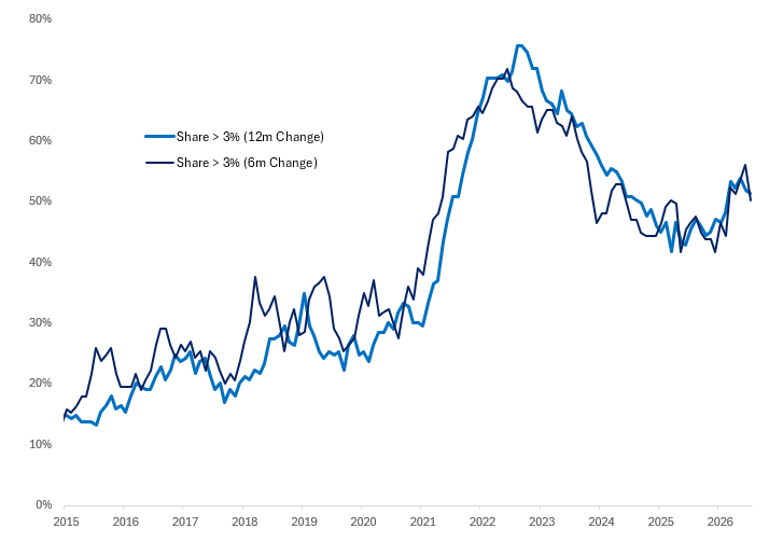
This assessment of the economy is very similar to our own and explains why we have been consistently on the hawkish side of front-end pricing all year. However, there is one significant wrinkle in the logic of the implied reaction function. Through the lens of the indicators Chair Warsh chose to elevate in the speech, the ex-ante case for tightening appears to us stronger in July than it does today. At the July meeting, the latest published 12-month change in the headline PCE price index was 4.1% (vs 3.7% today), while the six-month annualized change was around 5.3% (vs 4.1% today). The staff had already estimated that the June data, due for publication the following day, would lower the 12-month rate to 3.7 percent; however the information then available still implied a six-month pace of roughly 4.5% (vs 4.1% today). The unemployment rate was 4.2%, the three- and six-month averages of payroll growth were 111k and 92k, respectively, on the data vintage then available; those averages now stand at 20k and 44k, with a 4.1% unemployment rate. Furthermore – at the July meeting our inflation breadth measure was 56% on a 6m annualized basis vs 50% today, and 52% vs 51% respectively on a 12-month-change basis. Commodity prices, as measured by BCOM, are 6.8 percent higher than at the July meeting, while financial conditions are approximately 30bp easier, despite the increase in long-end rates.
Whilst its possible that the Committee saw some option value in waiting, it is hard to reconcile what we know about July and what the speech implies about September with a coherent reaction function, given the data broadly skews softer in the interim period. On the indicators Chair Warsh chose to elevate at Jackson Hole, inflation was stronger and the contemporaneous payroll picture materially healthier in July, while financial conditions have subsequently eased. On balance, we would characterize the data as consistent with some insurance-driven policy tightening amid a resilient economy. However – on the basis of the contemporaneous inflation and labor market evidence, the ex-ante case for a July hike looks stronger than the case for a September hike, hence we find the timing of his updated policy framing hard to square with the chronology of the data.
We think the speech raises the bar to remain on hold in September, and boxes the Fed in to some degree. However, the intertemporal inconsistency in the application of the reaction function gives us pause in fully internalising the newfound hawkishness. It may well be that the July decision and press conference are retrospectively viewed as mistakes, and that Jackson Hole represents atonement for those errors. Whilst we have no bones to pick with the assessment of the economy or the case for some insurance driven policy tightening, we will need to see the hike delivered before fully internalizing the reaction function. Actions speak louder than words.
The Inflation Breath is Elevated but Lower than in it was at the July Meeting
Share of PCE Basket Rising > 3% on a 6m and 12m Change Basis
Source: Bloomberg, Citadel Securities, data as of Aug 2026. Figures are for illustrative purposes only. Past performance does not guarantee future returns.
Copyright © Citadel Enterprise Americas LLC or one of its affiliates. All rights reserved.
Legal Entities Disseminating this Material: This material is disseminated in the United Kingdom by Citadel Securities (Europe) Limited (“CDGE”) authorized and regulated by the Financial Conduct Authority (“FCA”) (Registered company number: 05462867); in the European Union by Citadel Securities GCS (Ireland) Limited (“CSGI”) and its Paris Branch authorized and regulated by the Central Bank of Ireland (“CBI”) (Registration Number: C173437); in Hong Kong by Citadel Securities (Hong Kong) Limited (“CDHK”) licensed by the Securities and Futures Commission of Hong Kong (“SFC”), in Japan by Citadel Securities Japan Co., Ltd (“CSJC”) registered as a Type 1 financial instruments business operator with the Japan Financial Services Agency (“JFSA”); and in the United States of America by Citadel Securities LLC (“CDRG”) registered with the Securities Exchange Commission (“SEC”), Financial Industry Regulatory Authority (“FINRA”), and Securities Investor Protection Corporation (“SIPC”), Citadel Securities Institutional LLC (“CSIN”) registered with the SEC, FINRA, and SIPC, or Citadel Securities Swap Dealer LLC (“CSSD”) registered with the SEC, Commodities Futures Trading Commission (“CFTC”), and National Futures Association (“NFA”). Unless governing law permits otherwise, you must contact a Citadel Securities entity in your home jurisdiction if you want to use our services in effecting a transaction in any financial instruments or securities, including derivatives.
FOR INSTITUTIONAL USE ONLY; FOR PROFESSIONAL CLIENTS AND ELIGIBLE COUNTERPARTIES ONLY. This material is not intended as and does not constitute investment research. Contents of this material will be strictly limited to non-specific, generic information (i.e. macro events/topics) and are not subject to the Markets in Financial Instruments directive (MiFID II) or FINRA research rules. This material does not constitute an offer, solicitation, invitation, or inducement to purchase, acquire, subscribe to, provide, or sell any financial instrument or otherwise engage in investment activity. Please see additional important disclosures, including disclosures that may be relevant to your country of residence or business at www.citadelsecurities.com/GlobalSalesTrading.