Back in early July we laid out the bearish case for bonds in A Cruel Summer for Fixed Income. We now see the asymmetry as skewed towards lower long end yields for three core reasons: 1) we think incremental central bank credibility concerns are overstated 2) our CTA analysis implies positioning is stretched vs recent history 3) the co-incident valuation of our growth and policy factors implies downside to yields in the next few months.
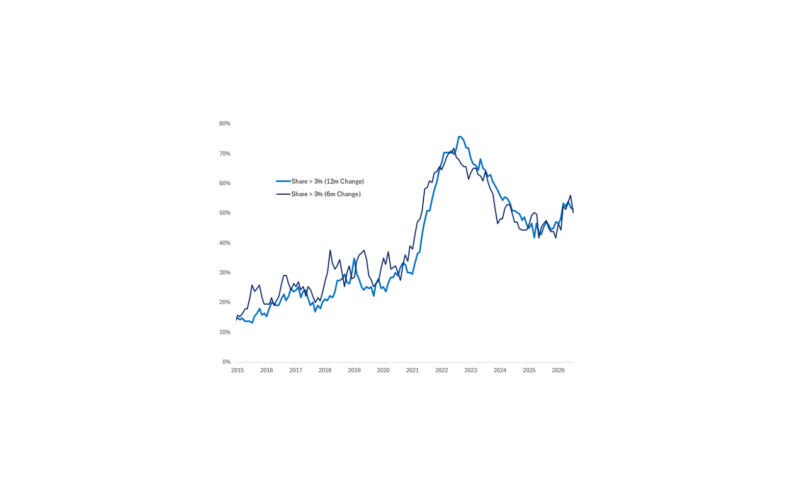
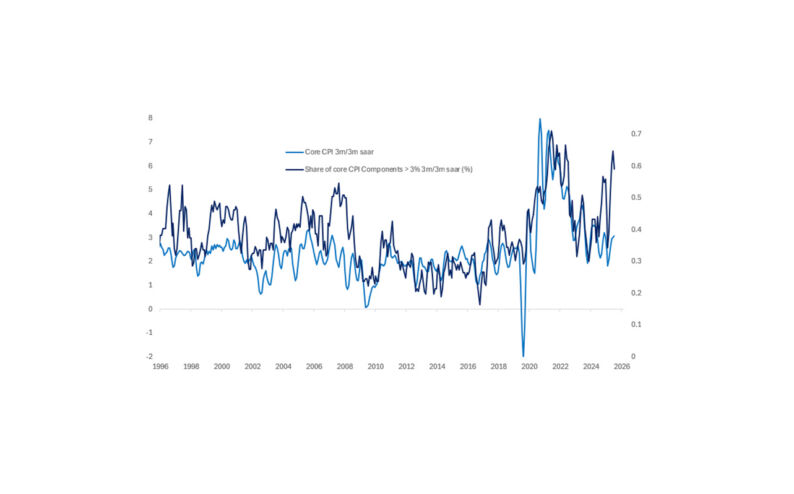
We made the case before the July meeting that the Fed (and Chair Warsh specifically) had a lot to gain from a July hike, both in terms of signaling independence and a lack of tolerance for an inflation overshoot. We think it is likely that the market would have rewarded that policy move in the form of lower long end yields and a reduction in term premium. Furthermore – the market response to Chair Warsh’s presser likely reflects a lack of clarity around his reaction function, given the divergence between the hawkish tone around inflation tolerance and lack of policy action, as well as a the disinclination to lay out scenario-based guidance, as well as raising questions around the yardstick used in the inflation target. At the margin all of these factors do raise some questions around credibility, however it would be remiss not to account for that fact that the data between the June meeting and today has been more dovish – payroll growth has missed as well as been revised downward and the last two inflation prints look substantially better than those which preceded them. We are tracking core PCE in the low 20s MoM, and once we strip out the volatile portfolio management category, market based core appears to be tracking around 15bp. Whilst two good prints do not make up for the five bad prints that preceded them, it seems the preference of the Fed is to extrapolate the trend in weaker prints, and dismiss the more elevated ones as driven by a string of one off factors. We had speculated that Chair Warsh was employing an adaptive policy framework, however policy action thus far appears more inertial, consistent with the pre-existing framework. It therefore appears September is a coin toss, containing very little asymmetry. We think that hiking would be of great benefit to the long end of the bond market, but the September meeting does it need to be the hinge point for global fixed income. The Fed has tolerated above target inflation for long enough, holding rates reflects simply more of the same and we see these credibility valuations as hard to sustain, especially given that the weaker data – for now – appears to have vindicated the more dovish reaction function.
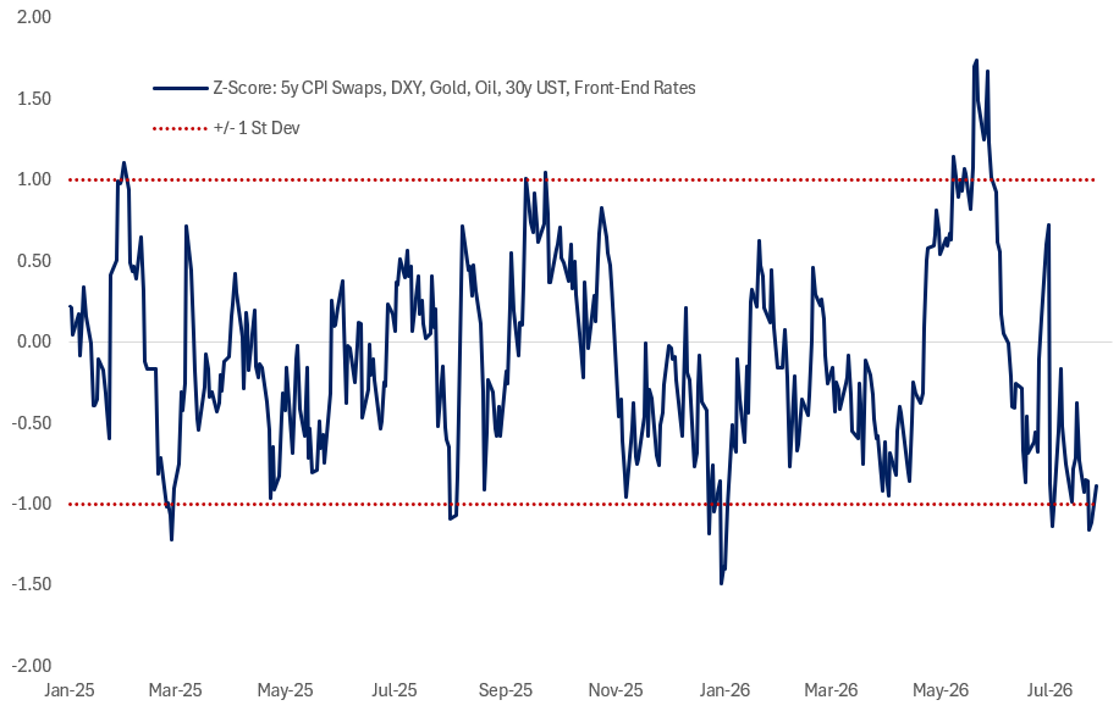
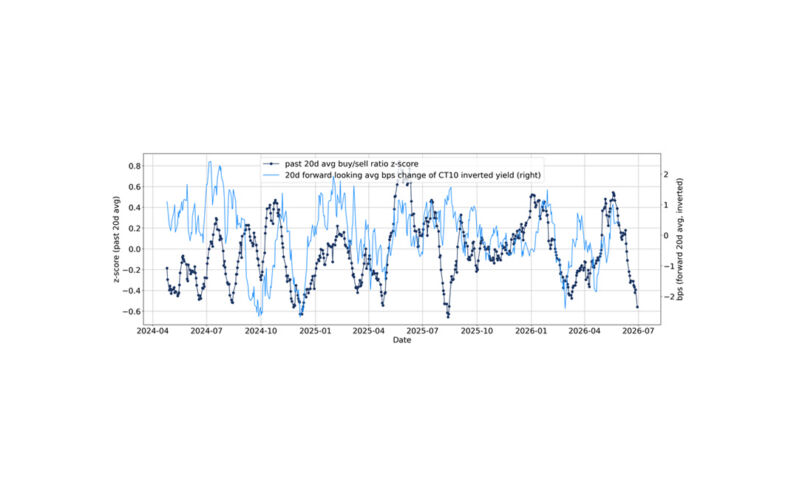
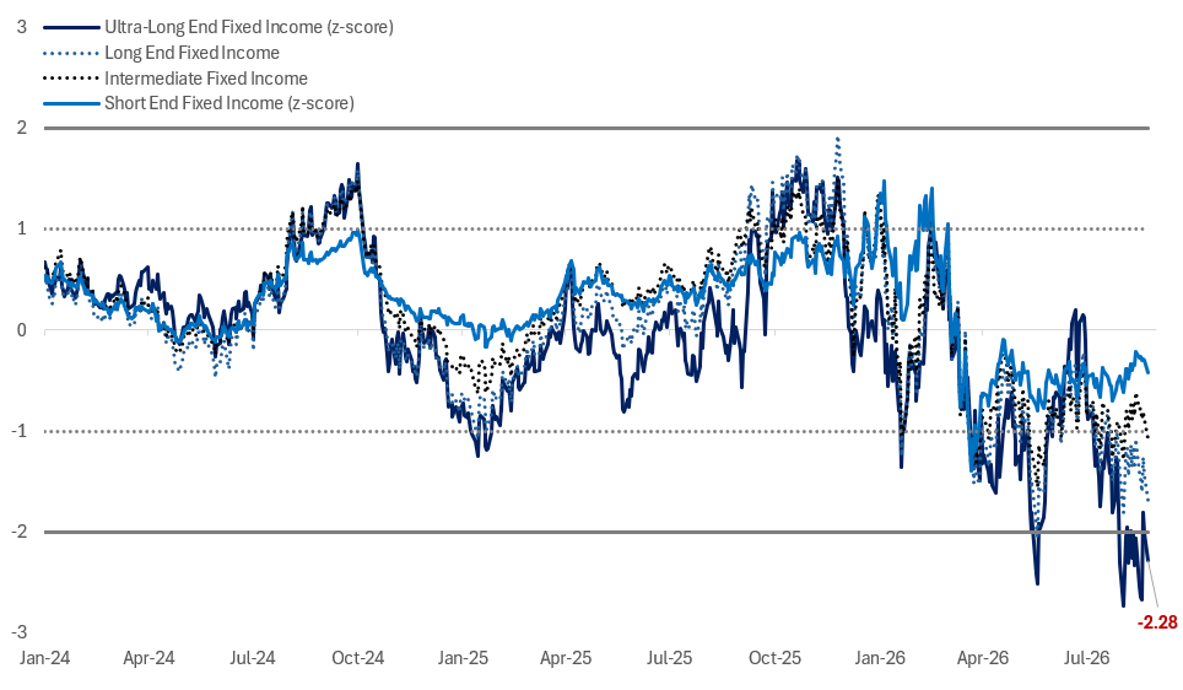
Our CTA simulation runs a collection of trend-following frameworks with varying adjustment speeds, to get a sense of positioning from the systematic community. It currently suggests that long end positioning looks quite stretched relative to its recent history (-2.28 sigma), which generally implies the balance of risks is somewhat asymmetric: further weakness should generate relatively modest incremental selling, while a sustained rally would force a more meaningful unwind of existing shorts and provide a mechanical tailwind to duration.
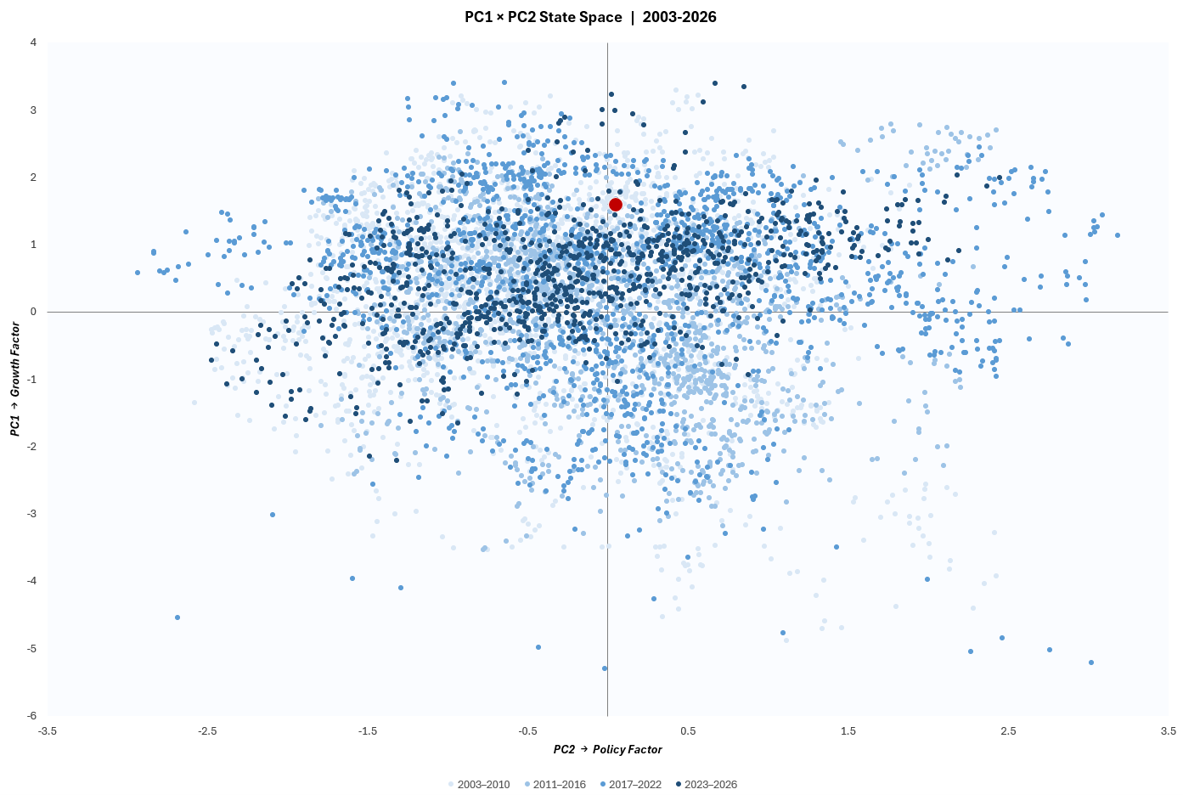
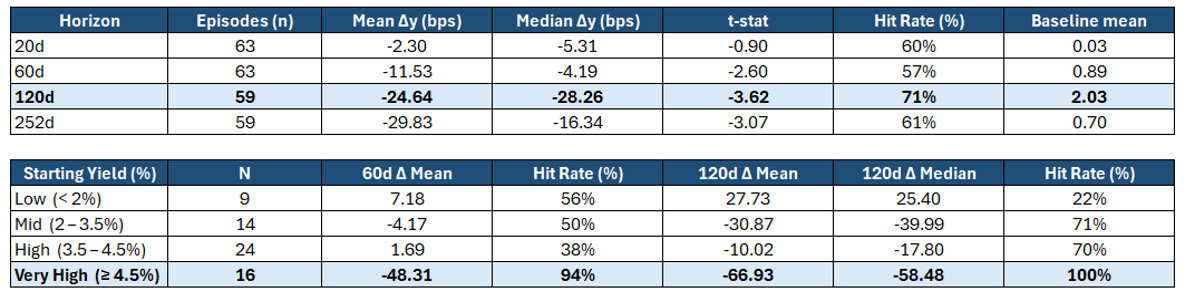
Finally, our macro framework compresses a range of cross asset market inputs into a Growth Factor (PC1) and a Monetary Policy Factor (PC2). We find that during periods where growth pricing was somewhat elevated, whilst policy pricing remained relatively benign (defined as PC1 >1.5 and PC2 <0), these regimes tended to precede meaningful rallies in US fixed income over the following months, particularly when yields were already towards the upper end of their cycle range. The PC1 currently sits at around 1.59 and the PC2 around 0.05, so we rerun the exercise using these readings as the hurdle. Across 64 comparable episodes since 2003, yields subsequently fall by an average 12bp over 60 days, 25bp over 120 days with yields lower in 71% of cases. Using the 120d period as the focus, the median move (-28bp) is slightly larger than the mean (-25bp), implying the typical episode rallied at least as much as the average, suggesting the result is not being skewed by a handful of outsized moves in the distribution. Importantly, yields exhibit essentially no drift over the same horizons outside these regimes, suggesting the result is in fact conditional rather than simply capturing the secular decline in yields over parts of the sample. Furthermore, the signal becomes considerably stronger once we condition on today’s elevated starting point in level of yields (>4.5%), albeit with a naturally more limited number of observations. Across 16 historical episodes, yields rallied by an average 48bp over 60 days and 67bp over 120 days following the concurrence of PC1 and PC2 valuations comparable to today. There is naturally some mechanical benefit from conditioning on high starting yields, simply because there is more room for yields to fall. That said, the magnitude of the historical rallies, combined with strong statistical significance in both the yield-conditioned (t = -8.3 at 120d) and unconditional (t = -3.6 at 120d) samples, implies risks are potentially skewed to lower yields in coming months.
Copyright © Citadel Enterprise Americas LLC or one of its affiliates. All rights reserved.
Legal Entities Disseminating this Material: This material is disseminated in the United Kingdom by Citadel Securities (Europe) Limited (“CDGE”) authorized and regulated by the Financial Conduct Authority (“FCA”) (Registered company number: 05462867); in the European Union by Citadel Securities GCS (Ireland) Limited (“CSGI”) and its Paris Branch authorized and regulated by the Central Bank of Ireland (“CBI”) (Registration Number: C173437); in Hong Kong by Citadel Securities (Hong Kong) Limited (“CDHK”) licensed by the Securities and Futures Commission of Hong Kong (“SFC”), in Japan by Citadel Securities Japan Co., Ltd (“CSJC”) registered as a Type 1 financial instruments business operator with the Japan Financial Services Agency (“JFSA”); and in the United States of America by Citadel Securities LLC (“CDRG”) registered with the Securities Exchange Commission (“SEC”), Financial Industry Regulatory Authority (“FINRA”), and Securities Investor Protection Corporation (“SIPC”), Citadel Securities Institutional LLC (“CSIN”) registered with the SEC, FINRA, and SIPC, or Citadel Securities Swap Dealer LLC (“CSSD”) registered with the SEC, Commodities Futures Trading Commission (“CFTC”), and National Futures Association (“NFA”). Unless governing law permits otherwise, you must contact a Citadel Securities entity in your home jurisdiction if you want to use our services in effecting a transaction in any financial instruments or securities, including derivatives.
FOR INSTITUTIONAL USE ONLY; FOR PROFESSIONAL CLIENTS AND ELIGIBLE COUNTERPARTIES ONLY. This material is not intended as and does not constitute investment research. Contents of this material will be strictly limited to non-specific, generic information (i.e. macro events/topics) and are not subject to the Markets in Financial Instruments directive (MiFID II) or FINRA research rules. This material does not constitute an offer, solicitation, invitation, or inducement to purchase, acquire, subscribe to, provide, or sell any financial instrument or otherwise engage in investment activity. Please see additional important disclosures, including disclosures that may be relevant to your country of residence or business at www.citadelsecurities.com/GlobalSalesTrading.