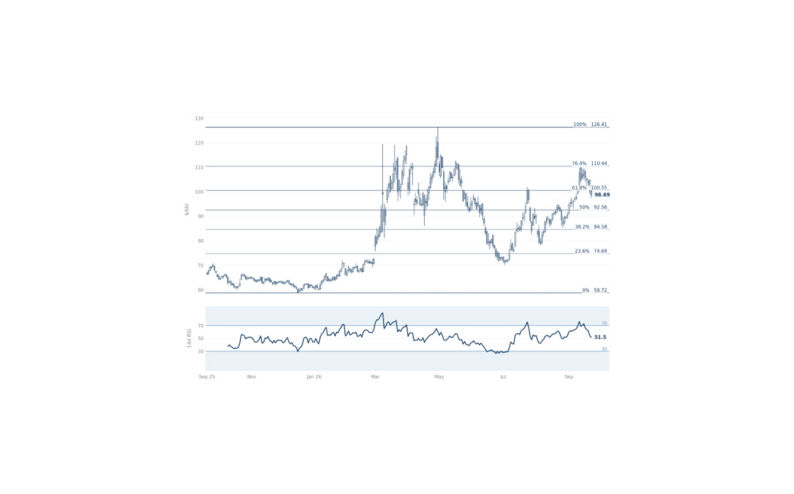
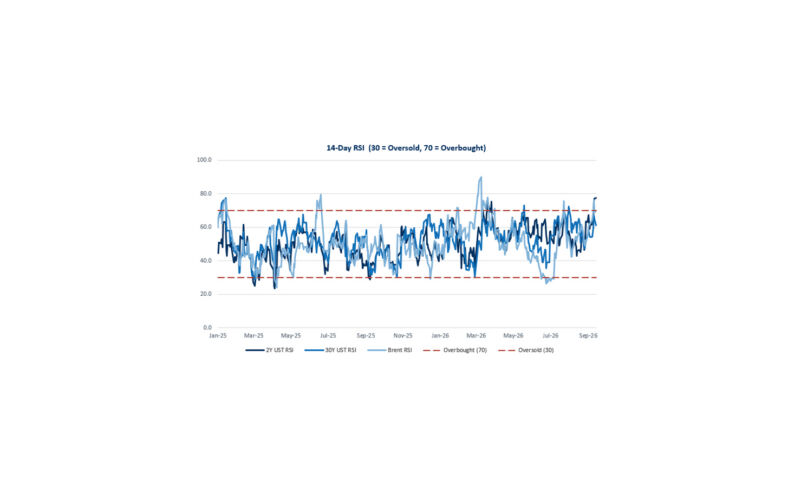
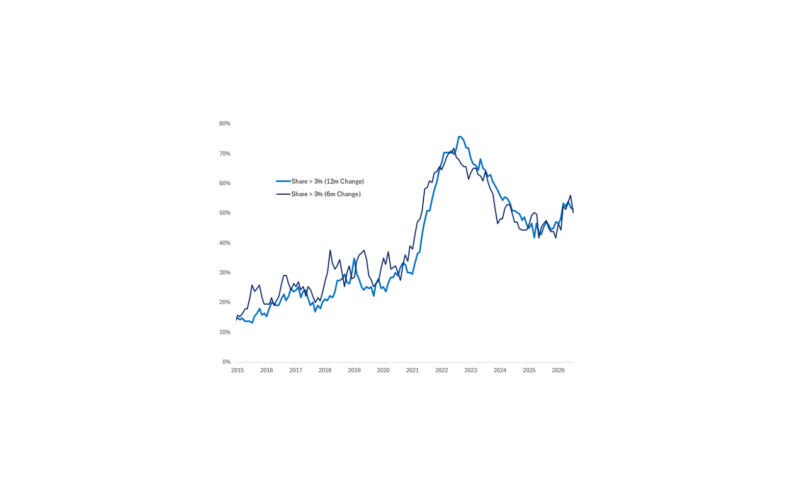
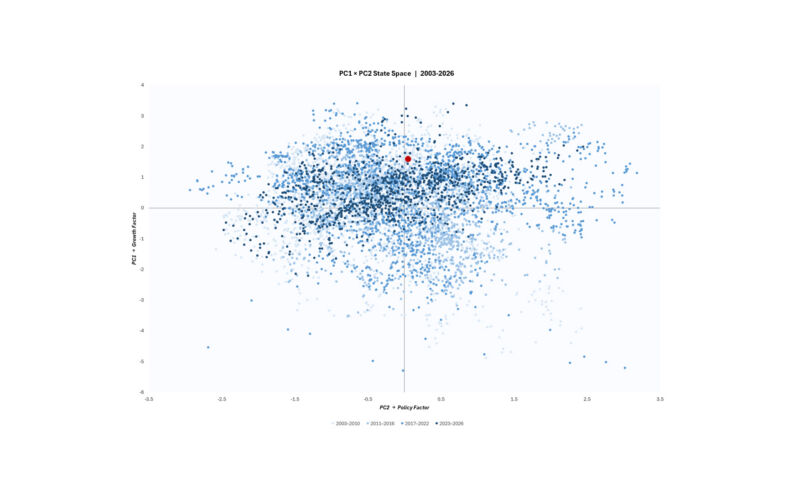
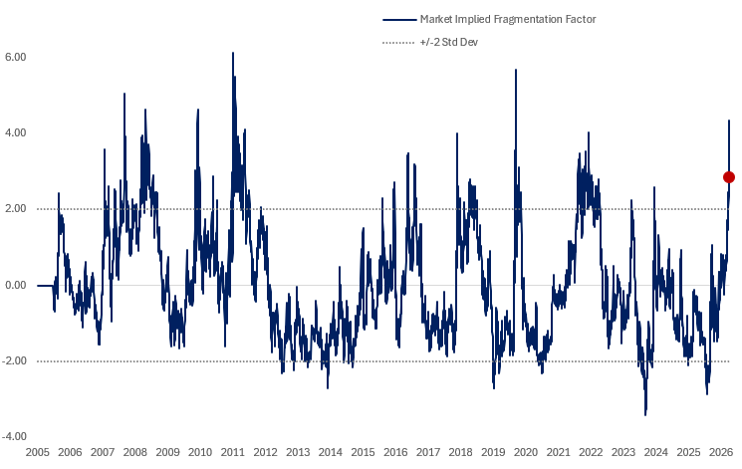
The widening in French government bond spreads appears quite dramatic on a standalone basis, but when compared with historical analogues using our European financial conditions framework, it looks broadly comparable with the stress imposed by previous episodes of sovereign stress and monetary tightening, while remaining less severe than during the pandemic or the European Sovereign Debt Crisis. This is because contagion to the wider euro area, while notable, appears relatively contained according to our decomposition. The speed of the widening in French spreads, which we consider may have been driven in part by deleveraging in front-end asset swaps, arguably lowered the bar for relief following the more constructive tone from Marine Le Penn. However, we see limited scope for spreads to return to the levels that prevailed before this episode and instead expect this higher and wider trading range to persist for some time.
Our PCA Fragmentation Factor is Elevated
PC3 Fragmentation Factor, European FCI Decomposition
Source: Bloomberg, Citadel Securities, data as of Oct 2026. Figures are for illustrative purposes only. Past performance does not guarantee future returns.
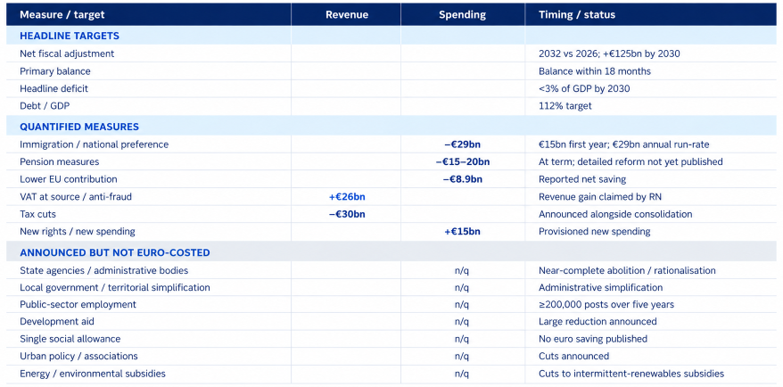
Marine Le Pen, currently the front-runner in polling for the 2027 presidential election, has proposed €140bn of net annual savings by 2032 relative to 2026, reaching primary balance within 18 months and reducing the deficit below 3% by 2030, backed by a constitutional “golden rule” on fiscal discipline. Whilst the tone was constructive on future fiscal plans, we struggle to see the political pathway to near-term consolidation and the credibility of the €140bn fiscal adjustment looks difficult to establish from the measures disclosed so far. More than 20% of the reported planned net savings come from changes to immigration policy, yet the experience across Europe suggests that materially reducing migration can be difficult and costly, with the fiscal gains less straightforward once the effect of weaker labour-force growth on potential output is taken into account. The reported proposed reduction in France’s contribution to the EU is similarly unclear, as the relevant number is the net saving after accounting for receipts from the EU budget rather than the much larger gross contribution. Additionally, the reported planned gain from VAT-at-source and anti-fraud measures appears to depend on a very large improvement in collection efficiency and we think could fall short of the full €26bn accounted for. The spending reduction program also appears to rely on cuts to state agencies, local government, development aid, urban policy and associations, alongside a reduction of at least 200,000 public-sector posts over five years, but the reporting currently provides little detail on the euro savings attached to many of those measures. Furthermore, Le Pen implied a pension overhaul could generate €15–20bn of long-term savings, but it is unclear how this fits with her August proposal to lower the retirement age to 62. We consider that fiscal consolidation of this scale requires considerably more detail before these plans can provide a credible anchor for sovereign yields, particularly with the deficit expected at 5.4% of GDP this year, following 5.4%, 5.8% and 5.1% in 2023, 2024 and 2025 respectively, and debt/GDP having risen correspondingly from 109.5% to 112.6% to 115.7%, with more than €150bn added in 2025 alone.
Guideline Fiscal Outlook and RN Counter-Budget
Fiscal Proposals EUR Bn
Source: Marine Le Pen 6 Oct 2026 speech, Reuters. Figures are for illustrative purposes only. Past performance does not guarantee future returns.
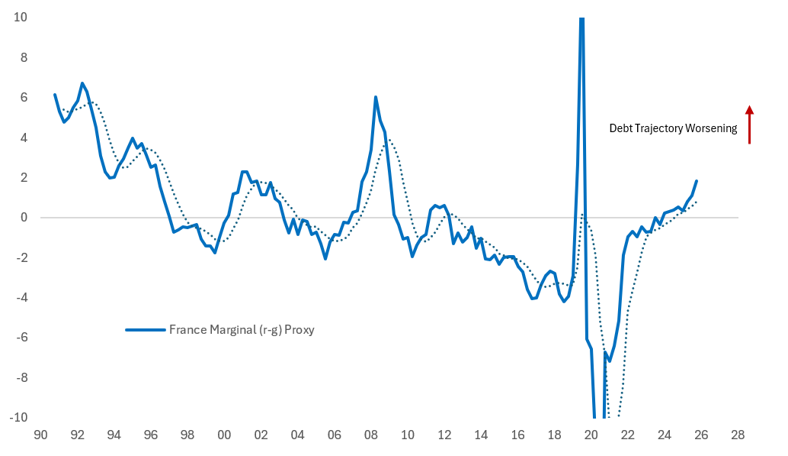
Furthermore, the rise in global yields is progressively increasing the fiscal adjustment required to stabilise debt/GDP. Consider that, if sustained, the c.130bp increase in yields since the end of 2025 would add approximately €4.4bn to annual interest expense, equivalent to 0.14% of GDP. This seems highly relevant in the context of a budget negotiation seeking to reduce the deficit by just 40bp, to 5% of GDP, and illustrates the sensitivity of the fiscal balance to absolute yield levels. Ultimately, this largely comes down to the economics of fiscal sustainability, which are shaped by the interaction between the primary balance, borrowing costs and the nominal growth rate of the economy. The standard framework compares the effective interest rate paid on government debt, (r), with nominal GDP growth, (g): when (r>g), the government generally needs to run a primary surplus of sufficient size to stabilise debt/GDP.

The IMF estimates France’s effective interest rate at 2.2%, broadly the weighted-average cost of the existing debt stock, against nominal growth of 2.2%, leaving (r-g) around zero. It then expects that relationship to improve by roughly 70bp in 2027, driven by both a lower effective interest rate and higher real and nominal growth. That appears somewhat difficult to reconcile with current market pricing: as lower-cost debt matures and is refinanced at higher prevailing yields, the effective rate would likely face upward pressure, unless that effect is offset by decline in shorter-term funding costs or other favourable changes in the debt mix.
Higher Yields are Putting Pressure on Debt Dynamics
Source: Bloomberg, Citadel Securities, data as of Oct 2026. Figures are for illustrative purposes only. Past performance does not guarantee future returns.
The IMF expects France’s nominal growth rate to be 2.7% in 2027, around 205bp below the current 10-year OAT yield of 4.75%, which is broadly representative of France’s marginal refinancing cost given the weighted-average maturity of new issuance. As progressively more low-cost debt is refinanced at yields above nominal growth, this implies the effective interest rate should drift higher and the debt arithmetic deteriorate unless offset by a stronger primary balance. Indeed, the IMF’s longer-term projections eventually move in that direction, with (r) exceeding (g) in 2033 before stabilising. By 2032, the year in which Marine Le Pen proposes to deliver €140bn of net annual savings, the IMF assumes an effective interest rate of 2.8% against nominal growth of 2.9%; with debt/GDP projected at 121.8%, that leaves room for a primary deficit of only around 0.12% of GDP if the debt ratio is to stabilise.

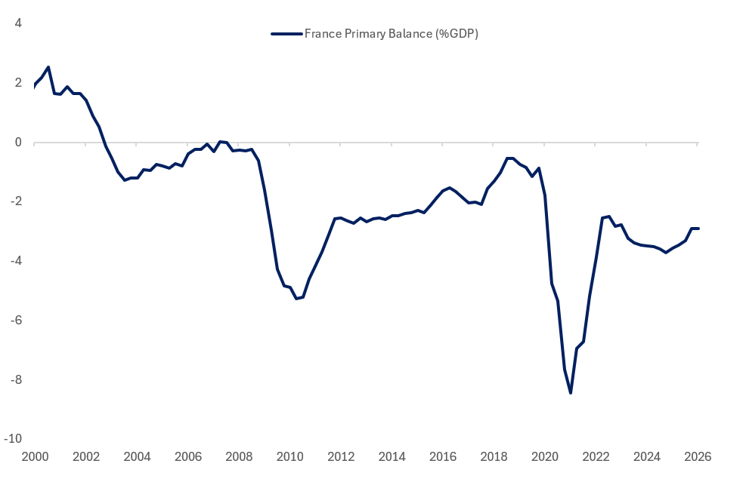
This calculation implies that France’s debt arithmetic requires substantial fiscal consolidation even under the IMF’s relatively benign macro and fiscal assumptions, with the current 2.9% primary deficit needing to narrow to approximately 0.1% of GDP by 2032 to stabilise debt, implying an improvement of around 2.8% before stock-flow adjustments. Le Pen’s proposed €140bn of net annual savings, equivalent to 4.6% of 2026 GDP and 3.85% of projected 2032 GDP, appears to be sufficient in scale on a static calculation, but suffers significant credibility concerns: consolidation of this magnitude could weigh on growth and tax receipts, reducing part of the apparent fiscal gain, while several of the largest proposed savings remain insufficiently specified or appear difficult to reconcile with other policy commitments. Whilst the proposal was taken as constructive by the market in the context of recent spread widening, a sustained rally is likely to require a much fuller account of where the savings will come from, broader political acceptance of the adjustment required and sufficient parliamentary and public support to carry the measures through successive budgets. France has fallen short of its fiscal targets on several occasions in recent years and still runs a primary deficit close to 3% of GDP. Moving from repeated slippage to a multi-year consolidation of this scale would likely require a considerable degree of political discipline and unity, which may be challenging to achieve. We therefore think the new higher and wider range for French spreads is likely to remain for some time.
Achieving Primary Balance Would be a Departure from Recent History
France Primary Balance % GDP
Source: Macrobond, Citadel Securities, data as of Oct 2026. Figures are for illustrative purposes only. Past performance does not guarantee future returns.
Copyright © Citadel Enterprise Americas LLC or one of its affiliates. All rights reserved.
Legal Entities Disseminating this Material: This material is disseminated in the United Kingdom by Citadel Securities (Europe) Limited (“CDGE”) authorized and regulated by the Financial Conduct Authority (“FCA”) (Registered company number: 05462867); in the European Union by Citadel Securities GCS (Ireland) Limited (“CSGI”) and its Paris Branch authorized and regulated by the Central Bank of Ireland (“CBI”) (Registration Number: C173437); in Hong Kong by Citadel Securities (Hong Kong) Limited (“CDHK”) licensed by the Securities and Futures Commission of Hong Kong (“SFC”), in Japan by Citadel Securities Japan Co., Ltd (“CSJC”) registered as a Type 1 financial instruments business operator with the Japan Financial Services Agency (“JFSA”); and in the United States of America by Citadel Securities LLC (“CDRG”) registered with the Securities Exchange Commission (“SEC”), Financial Industry Regulatory Authority (“FINRA”), and Securities Investor Protection Corporation (“SIPC”), Citadel Securities Institutional LLC (“CSIN”) registered with the SEC, FINRA, and SIPC, or Citadel Securities Swap Dealer LLC (“CSSD”) registered with the SEC, Commodities Futures Trading Commission (“CFTC”), and National Futures Association (“NFA”). Unless governing law permits otherwise, you must contact a Citadel Securities entity in your home jurisdiction if you want to use our services in effecting a transaction in any financial instruments or securities, including derivatives.
FOR INSTITUTIONAL USE ONLY; FOR PROFESSIONAL CLIENTS AND ELIGIBLE COUNTERPARTIES ONLY. This material is not intended as and does not constitute investment research. Contents of this material will be strictly limited to non-specific, generic information (i.e. macro events/topics) and are not subject to the Markets in Financial Instruments directive (MiFID II) or FINRA research rules. This material does not constitute an offer, solicitation, invitation, or inducement to purchase, acquire, subscribe to, provide, or sell any financial instrument or otherwise engage in investment activity. Please see additional important disclosures, including disclosures that may be relevant to your country of residence or business at www.citadelsecurities.com/GlobalSalesTrading.