The midterm election results have important implications for the US macro outlook, with a more challenging environment for the AI investment cycle, a potentially accelerated resolution to the Iran conflict and a political realignment towards the centre ahead of 2028. The electoral backlash against data-centre development introduces new constraints on the pace of AI infrastructure deployment, although the geographical mobility of capital should limit the ultimate impact on aggregate investment. The more immediate consequences are likely to be slower construction, greater execution risk and a redistribution of returns along the AI supply chain, favouring businesses with operational and energized compute over hardware suppliers exposed to deployment delays. For index level risk assets, these headwinds may be offset if the Iran war reaches a quicker diplomatic settlement than previously expected. The scale of the Republican defeat may create some urgency in Washington to negotiate which could align with Tehran’s apparent incentive to monetise its remaining leverage. Meanwhile, the breadth of the swing against Republicans, alongside the relative outperformance of centrist Democrats, suggests a political recalibration towards the centre as both parties look ahead to 2028. We therefore see competing forces for equities, likely to manifest in a “Peak Capex” rotation, but a more consistent directional impulse for rates, with slower near-term investment, a marginal reduction in near term financing demand and the prospect of lower energy prices all favouring lower yields.
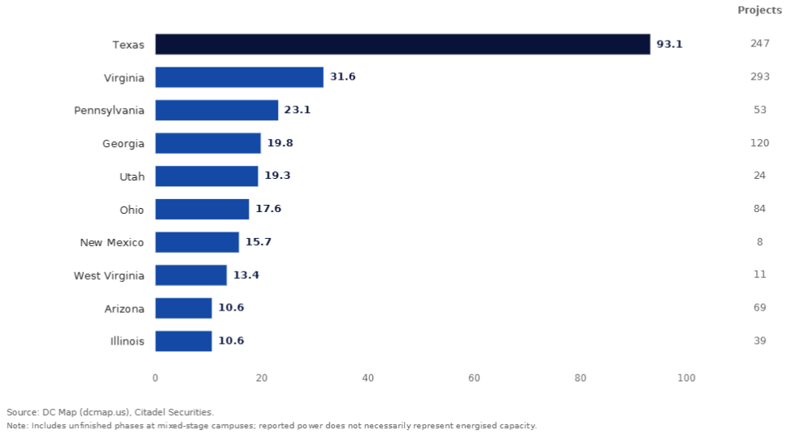
The election suggests the data-centre buildout may face a tougher regulatory and permitting environment. 56% of voters described AI and data centres as a crucial or major factor in their congressional vote and voters opposed data centre development in at least 39 of the 45 local ballot initiatives on the issue. The potential exposure is substantial, with around 45 GW across 350 projects in Texas, Ohio, Pennsylvania and Georgia at risk between 2026–30, including 24 GW in Texas alone, a state accounting for a substantial share of planned/marginal US capacity by 2030. Viewed through the lens of general equilibrium, however, the impact on aggregate investment is likely to be considerably smaller, as restrictions in one jurisdiction create incentives for capital and construction to migrate elsewhere eventually. Provided demand for compute remains strong, restrictions in one jurisdiction should encourage investment to migrate towards others willing and able to accommodate it, with the scarcity of available capacity sustaining the incentive to build. Securing alternative sites, power and approvals takes time, so this adjustment could still materially delay deployment and raise costs. We would therefore expect some moderation in the near-term growth and inflation impulse from construction and associated resource demand, alongside a smaller impact on cumulative investment and financing requirements.
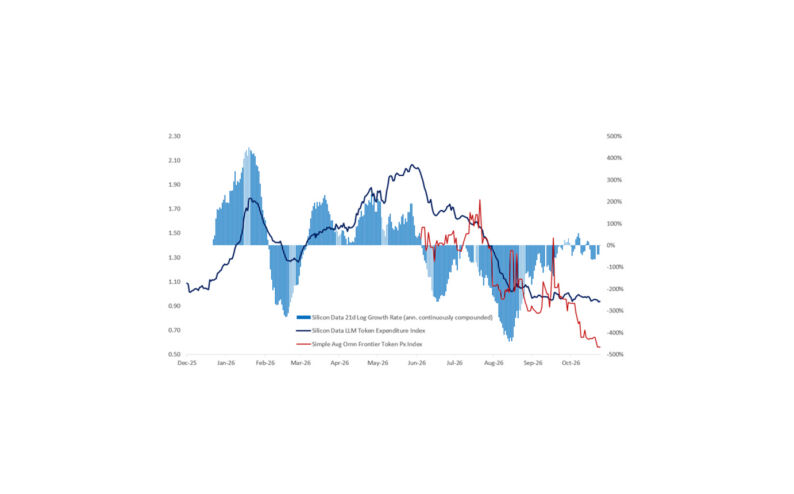
The rotational consequences of the election we think diverge sharply along the supply chain, with markets increasingly likely to chase a “peak AI capex” theme, rotating out of memory, neoclouds and energy, and into staples, healthcare, banks, housing, retail and, in line with our Tokenomics 2.0 view: the hyperscalers themselves. The underlying intuition is that a slower buildout could be relatively favourable for those doing the spending, and potentially less so for those receiving it. For the hardware “picks and shovels”, slower delivery of powered buildings raises the risk that component production runs ahead of installation, leaving suppliers exposed to order deferrals and excess inventories even while usable compute remains scarce; this vulnerability is likely most pronounced in memory, optical and other semiconductor components.
For cloud businesses already selling energised compute, or bringing fully permitted capacity with secured power online shortly, delayed competition should instead support utilisation, pricing power and prospective margins, while reducing the risk of an eventual capacity glut. For the hyperscalers themselves, some moderation in the pace of capital expenditure should also provide relief to free cash flow and financing requirements. With CBRE reporting just 1.4% vacancy across its primary North American markets and 80.4% of capacity under construction already preleased, additional barriers to entry should reinforce the scarcity value of operational assets. The relative beneficiaries should therefore be the businesses able to supply compute now, with a stronger claim on the economics of the investment cycle as physical expansion becomes harder. This should also create considerable scope for differentiation through stock selection, with the geographical distribution of development pipelines, particularly exposure to Texas and other jurisdictions facing tighter permitting restrictions, becoming an increasingly important determinant of execution risk, the timing of revenue realisation and ultimately relative valuations.
For risk assets in aggregate, we still see slower deployment and greater execution risk as an adverse development, notwithstanding the rotation towards sectors less exposed to the AI investment cycle. While the election removes an important source of political uncertainty, the argument for treating it as a clearing event seems less compelling when the outcome itself implies a more challenging investment environment for the AI build out, particularly given the extent of the swing was larger than expected. For rates, the combination of risk aversion, a potentially softer near-term investment impulse and possible modest financing deferrals should favour lower yields, although the geographical mobility of capital suggests caution in extrapolating this into a lasting collapse in either spending or issuance.
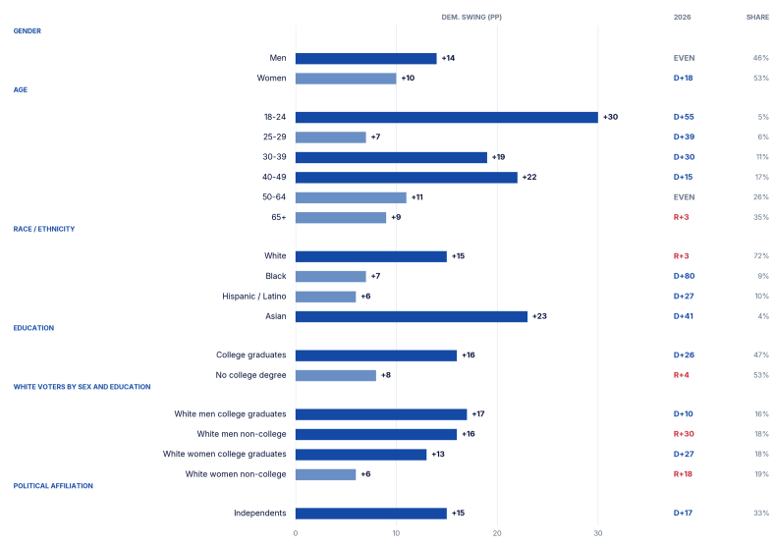
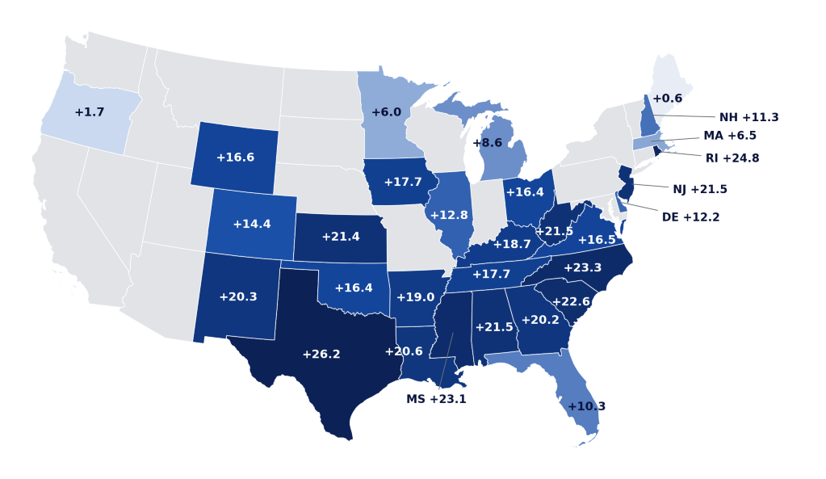
The scale and breadth of the demographic swing against Republicans suggest that Trump’s governing choices have weakened the coalition that returned him to office. The Iran war, tariffs and renewed pressure on household purchasing power appear to have undermined his affordability agenda, with the sharp rise in gasoline and diesel prices particularly damaging for rural and agricultural communities across the Midwest, where Republican losses have been pronounced. The overlap between higher fuel-price exposure and the swing against Republicans is striking, suggesting that the economic consequences of Trump’s policy choices have been felt particularly acutely in parts of his traditional electoral base.
Relative to the 2022 midterms, the Republican advantage among men has disappeared, having stood at 14 points, while its lead among white men has narrowed from 28 to 12 points. Even among white men without a college degree, arguably the most historically dependable constituency in the Republican electoral base, the margin has fallen from 46 to 30. The Republican advantage among non-college graduates more broadly has declined from 12 to four points, and among voters over 65 from 12 to three, while the Democratic margin among women has widened from eight to 18 points and among college graduates from ten to 26. These appear to be substantial reversals extending deep into the Republican base, consistent with voters responding to economic outcomes that may have fallen short of expectations. Alongside what looks like an erosion of Trump’s 2024 gains among younger and Hispanic voters, the results may leave Republicans weighing both the consequences of his policy choices and the potential fragility of a highly personalised coalition that may not persist without the President on the ballot in 2028.
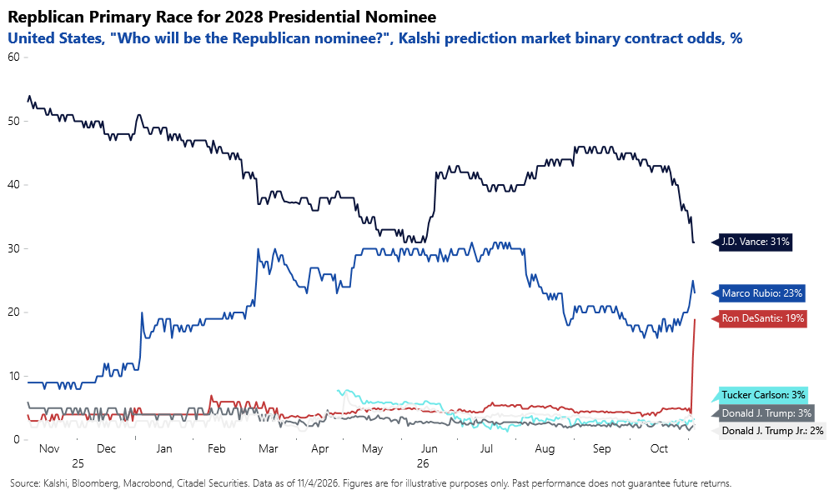
We think that combination strengthens the case for a more conventional Republican nominee capable of recovering the political centre in 2028. Prediction markets have already begun repricing this shifting balance of power. For example, Ron DeSantis’s implied probability of securing the nomination has risen from roughly 4% before the results to around 19%, while JD Vance’s has fallen from approximately 36% to 31%, leaving him the favourite but with a diminished advantage. We are inclined to read the DeSantis move primarily as an increased premium on distance from the administration’s governing record. The Republican party could find itself carrying the liabilities of Trump’s time in office without the candidate-specific turnout advantages that helped assemble a broad but ultimately less stable coalition of voters.
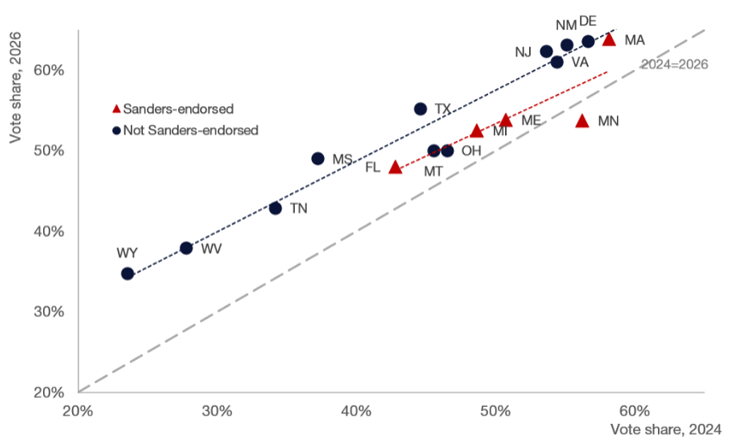
We see two further important implications of the election for the strategic US macro outlook. First, the Democratic resurgence appears to have been considerably stronger among more centrist candidates than those on the party’s left flank. Across the 17 states that held Senate races in both 2024 and 2026, the average Democratic swing relative to the 2024 presidential election was 6.7 percentage points, but this fell to just 3.1 points among candidates endorsed by Bernie Sanders, compared with 8.1 points for those without his endorsement. While these comparisons may have been influenced by differences in state electorates and candidate characteristics, we think the divergence is striking given the scale of the national swing, suggesting that the electorate’s repudiation of the Trump administration should not necessarily be interpreted as an endorsement of a substantially more progressive economic agenda. The results may therefore strengthen the influence of the Democratic Party’s more moderate wing as attention turns towards 2028, with implications for the eventual direction of fiscal, tax and regulatory policy.
Furthermore, the election may have materially increased the political urgency of bringing the Iran war to a conclusion. Both President Trump and Vice President Vance have attributed Republican losses, at least in part, to the conflict, reinforcing the political costs of prolonging a war whose consequences for energy prices and household purchasing power have been particularly damaging among traditional Republican constituencies. We argued in Iran – Peak Gamma that Tehran’s strategic position resembled a long, high-strike oil call expiring around the US midterms, with its capacity to extract political concessions through disruption to energy markets approaching a maximum ahead of the election, before the time value of that leverage evaporated and escalation dominance was lost. Recent diplomatic developments in the immediate lead up to the midterms could be interpreted as a sign that Tehran may indeed be attempting to monetize its remaining leverage through a negotiated settlement. Notably, the election suggests that Washington’s incentives to reach an agreement may also have strengthened, which could bring the political calculus of both sides into closer alignment.
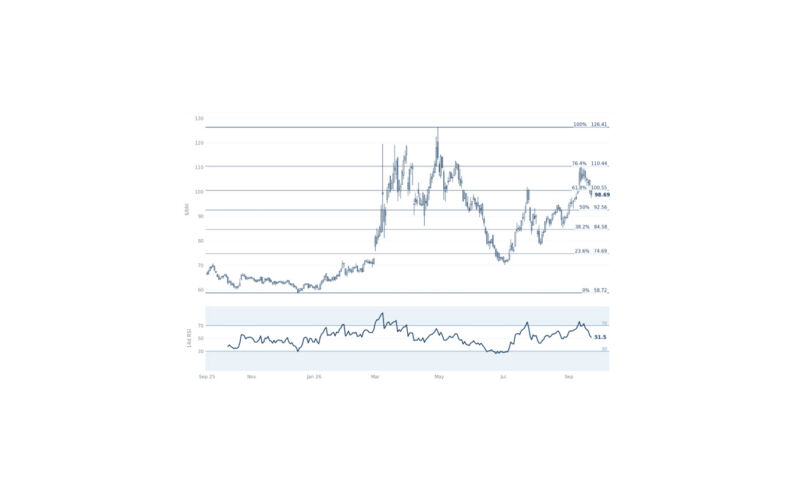
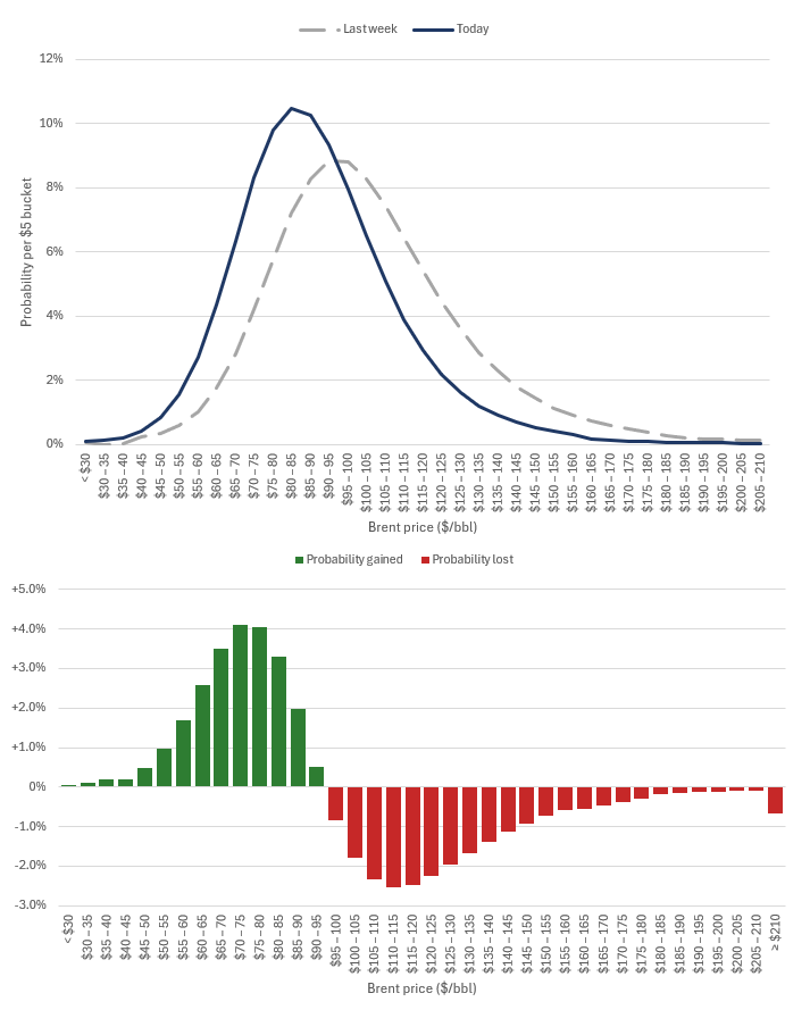
With substantial crude flows already being sustained through and around the Strait of Hormuz, we suspect a credible diplomatic resolution could precipitate further compression in energy risk premia and our analysis of the oil option market implies the market has begun to substantially reduce the upside premium embedded in the last week. Specifically, the three-month option-implied probability of Brent exceeding $120 has more than halved since 28th October, from 23% to 9%, while the one-month probability has collapsed from 27% to just 7%. Upside skew has also flattened across shorter maturities, suggesting that markets have been progressively removing the premium associated with a renewed escalation in the conflict. The direction and concentration of these distributional price adjustments are consistent with our thesis that the midterms could catalyse a resolution.
Copyright © Citadel Enterprise Americas LLC or one of its affiliates. All rights reserved.
Legal Entities Disseminating this Material: This material is disseminated in the United Kingdom by Citadel Securities (Europe) Limited (“CDGE”) authorized and regulated by the Financial Conduct Authority (“FCA”) (Registered company number: 05462867); in the European Union by Citadel Securities GCS (Ireland) Limited (“CSGI”) and its Paris Branch authorized and regulated by the Central Bank of Ireland (“CBI”) (Registration Number: C173437); in Hong Kong by Citadel Securities (Hong Kong) Limited (“CDHK”) licensed by the Securities and Futures Commission of Hong Kong (“SFC”), in Japan by Citadel Securities Japan Co., Ltd (“CSJC”) registered as a Type 1 financial instruments business operator with the Japan Financial Services Agency (“JFSA”); and in the United States of America by Citadel Securities LLC (“CDRG”) registered with the Securities Exchange Commission (“SEC”), Financial Industry Regulatory Authority (“FINRA”), and Securities Investor Protection Corporation (“SIPC”), Citadel Securities Institutional LLC (“CSIN”) registered with the SEC, FINRA, and SIPC, or Citadel Securities Swap Dealer LLC (“CSSD”) registered with the SEC, Commodities Futures Trading Commission (“CFTC”), and National Futures Association (“NFA”). Unless governing law permits otherwise, you must contact a Citadel Securities entity in your home jurisdiction if you want to use our services in effecting a transaction in any financial instruments or securities, including derivatives.
FOR INSTITUTIONAL USE ONLY; FOR PROFESSIONAL CLIENTS AND ELIGIBLE COUNTERPARTIES ONLY. This material is not intended as and does not constitute investment research. Contents of this material will be strictly limited to non-specific, generic information (i.e. macro events/topics) and are not subject to the Markets in Financial Instruments directive (MiFID II) or FINRA research rules. This material does not constitute an offer, solicitation, invitation, or inducement to purchase, acquire, subscribe to, provide, or sell any financial instrument or otherwise engage in investment activity. Please see additional important disclosures, including disclosures that may be relevant to your country of residence or business at www.citadelsecurities.com/GlobalSalesTrading.