
I REGARD JENSEN AS A BRILLIANT GENERATIONAL FOUNDER. He was the driving force behind NVIDIA’s transformation from a gaming graphics company into the central infrastructure provider for the AI revolution…recognising the potential of general-purpose parallel computing long before today’s boom. He also built an exceptional team, many of whom will continue carrying the company forward…but they are not Jensen. I would be wary of the easy comparison with Apple after Steve Jobs. NVIDIA’s engineering capabilities, software ecosystem and customer relationships will not disappear overnight, supporting confidence in near-term execution. But the longer-term question is whether it retains the strategic vision and risk appetite that created those advantages. Exceptional founders combine the conviction and authority to commit their organisations to investments that professional managers would often struggle to justify. Elon and Zuck illustrate the point…repeatedly making substantial strategic bets before the returns were clear and persisting through criticism and setbacks. That willingness to take risks others would reject has been central to their success; assuming this same trajectory continues without the founder understates the contribution of individual excellence – something that I firmly believe is the core tenet behind any extraordinary organisation. New management may become more conservative, particularly around financing customers, potentially improving capital discipline whilst reducing support for the wider buildout. The more consequential risk is that this conservatism extends to the uncertain, long-term investments that have repeatedly expanded NVIDIA’s opportunity. Meanwhile, his departure is unlikely to end congressional investigations, and any resulting restrictions could still matter materially. NVIDIA can continue delivering strong results from the capabilities Jensen helped build…the harder question is whether his successors will take the risks required to create the next decade of growth.
Source: Ramp, Silicon Data, Citadel Securities
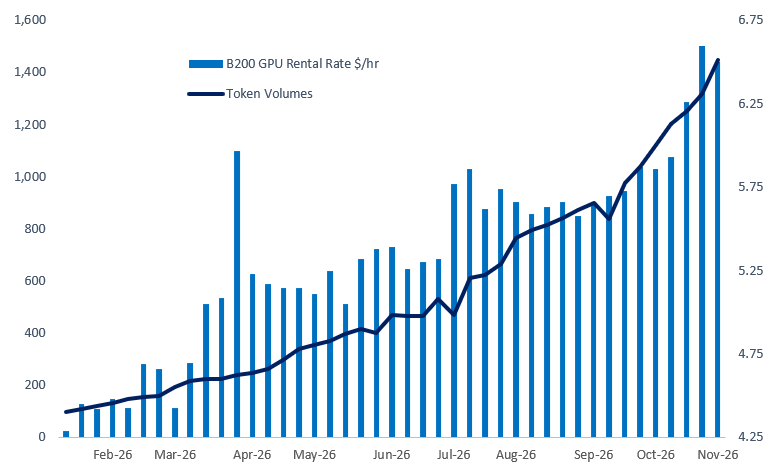
THE DEMAND FOR INTELLIGENCE CAN KEEP RISING EVEN AS THE ECONOMICS OF PRODUCING IT BECOME MORE CHALLENGING. This is the distinction I keep coming back to…the demand for AI, the profitability of frontier development and the returns from owning compute are increasingly different propositions. As I argued last week, political constraints on the buildout sharpen the distinction between capacity already operating and projects still awaiting permits, financing, and power. Observing the recent picture, CBRE’s H1 data show that supply across primary North American data-centre markets increased 33.7% YoY, yet vacancy fell to just 1.4%, whilst 80% of capacity under construction was already preleased. Rental rates for 3–10MW requirements rose 8.3%, suggesting substantial supply growth had still failed to eliminate scarcity. Microsoft’s latest results offer a more recent illustration…management attributed its capex shortfall to delayed third-party capacity deliveries, whilst continuing to describe customer demand as exceeding available supply. A lower spending number can therefore reflect difficulty delivering capacity even as underlying demand remains strong. In my mind, this reinforces the relative advantage of hyperscalers with operational compute, secure power access, established distribution and the flexibility to monetise multiple models. Provided demand remains resilient, restricting incremental supply should support utilisation and the scarcity value of the installed base. Of course, hyperscalers also need new capacity, face higher infrastructure costs, and depend on customers ultimately being able to pay. Nevertheless, a slower buildout can improve the economics of assets already earning revenues whilst making unfinished projects harder to justify. The premium increasingly belongs to compute that can earn a return today.For investors, the nature of regulation is therefore critical: constraints on construction can preserve the scarcity value of available compute, whilst restrictions on model development or deployment can weaken the demand expected to fill it. Anthropic generated more than 80% of Q3 revenue from models released in the preceding six months, illustrating the importance of frequent launches. A coordinated slowdown could reduce R&D costs, but restrictions that weaken demand would undermine the scarcity argument. Anthropic’s updated disclosures also illustrate how quickly the operating leverage can change. Q3 revenues increased ~47% QoQ to $17bn, whilst compute and infrastructure expenses rose ~77% to $9.9bn, taking their share of revenues back to 58%, from 48% in Q2. Adjusted operating profit increased in dollars, but the adjusted operating margin fell from 19% to 15%, with expensive short-term compute a significant pressure point. The filing also disclosed ~$901bn of multi-year purchase and lease commitments, substantially all related to compute and infrastructure, whilst ~$132bn of cash and short-term investments provides substantial financial flexibility. The challenge in frontier economics is sustaining adequate returns on an increasingly committed cost base. Competition can require another round of investment before the previous model has paid off, whilst cheaper alternatives put continual pressure on how much of each efficiency gain the developer retains. Put simply, generating an attractive margin from inference, covering the recurring cost of frontier research, and earning a satisfactory return on committed capital are three separate hurdles. Strong demand helps with all three…but guarantees none of them. This remains the structural reason for my greater confidence in platforms that can monetise the deployment of intelligence across multiple providers.
I REGARD JENSEN AS A BRILLIANT GENERATIONAL FOUNDER. He was the driving force behind NVIDIA’s transformation from a gaming graphics company into the central infrastructure provider for the AI revolution…recognising the potential of general-purpose parallel computing long before today’s boom. He also built an exceptional team, many of whom will continue carrying the company forward…but they are not Jensen. I would be wary of the easy comparison with Apple after Steve Jobs. NVIDIA’s engineering capabilities, software ecosystem and customer relationships will not disappear overnight, supporting confidence in near-term execution. But the longer-term question is whether it retains the strategic vision and risk appetite that created those advantages. Exceptional founders combine the conviction and authority to commit their organisations to investments that professional managers would often struggle to justify. Elon and Zuck illustrate the point…repeatedly making substantial strategic bets before the returns were clear and persisting through criticism and setbacks. That willingness to take risks others would reject has been central to their success; assuming this same trajectory continues without the founder understates the contribution of individual excellence – something that I firmly believe is the core tenet behind any extraordinary organisation. New management may become more conservative, particularly around financing customers, potentially improving capital discipline whilst reducing support for the wider buildout. The more consequential risk is that this conservatism extends to the uncertain, long-term investments that have repeatedly expanded NVIDIA’s opportunity. Meanwhile, his departure is unlikely to end congressional investigations, and any resulting restrictions could still matter materially. NVIDIA can continue delivering strong results from the capabilities Jensen helped build…the harder question is whether his successors will take the risks required to create the next decade of growth.
Source: Ramp, Silicon Data, Citadel Securities
THE DEMAND FOR INTELLIGENCE CAN KEEP RISING EVEN AS THE ECONOMICS OF PRODUCING IT BECOME MORE CHALLENGING. This is the distinction I keep coming back to…the demand for AI, the profitability of frontier development and the returns from owning compute are increasingly different propositions. As I argued last week, political constraints on the buildout sharpen the distinction between capacity already operating and projects still awaiting permits, financing, and power. Observing the recent picture, CBRE’s H1 data show that supply across primary North American data-centre markets increased 33.7% YoY, yet vacancy fell to just 1.4%, whilst 80% of capacity under construction was already preleased. Rental rates for 3–10MW requirements rose 8.3%, suggesting substantial supply growth had still failed to eliminate scarcity. Microsoft’s latest results offer a more recent illustration…management attributed its capex shortfall to delayed third-party capacity deliveries, whilst continuing to describe customer demand as exceeding available supply. A lower spending number can therefore reflect difficulty delivering capacity even as underlying demand remains strong. In my mind, this reinforces the relative advantage of hyperscalers with operational compute, secure power access, established distribution and the flexibility to monetise multiple models. Provided demand remains resilient, restricting incremental supply should support utilisation and the scarcity value of the installed base. Of course, hyperscalers also need new capacity, face higher infrastructure costs, and depend on customers ultimately being able to pay. Nevertheless, a slower buildout can improve the economics of assets already earning revenues whilst making unfinished projects harder to justify. The premium increasingly belongs to compute that can earn a return today.For investors, the nature of regulation is therefore critical: constraints on construction can preserve the scarcity value of available compute, whilst restrictions on model development or deployment can weaken the demand expected to fill it. Anthropic generated more than 80% of Q3 revenue from models released in the preceding six months, illustrating the importance of frequent launches. A coordinated slowdown could reduce R&D costs, but restrictions that weaken demand would undermine the scarcity argument. Anthropic’s updated disclosures also illustrate how quickly the operating leverage can change. Q3 revenues increased ~47% QoQ to $17bn, whilst compute and infrastructure expenses rose ~77% to $9.9bn, taking their share of revenues back to 58%, from 48% in Q2. Adjusted operating profit increased in dollars, but the adjusted operating margin fell from 19% to 15%, with expensive short-term compute a significant pressure point. The filing also disclosed ~$901bn of multi-year purchase and lease commitments, substantially all related to compute and infrastructure, whilst ~$132bn of cash and short-term investments provides substantial financial flexibility. The challenge in frontier economics is sustaining adequate returns on an increasingly committed cost base. Competition can require another round of investment before the previous model has paid off, whilst cheaper alternatives put continual pressure on how much of each efficiency gain the developer retains. Put simply, generating an attractive margin from inference, covering the recurring cost of frontier research, and earning a satisfactory return on committed capital are three separate hurdles. Strong demand helps with all three…but guarantees none of them. This remains the structural reason for my greater confidence in platforms that can monetise the deployment of intelligence across multiple providers.
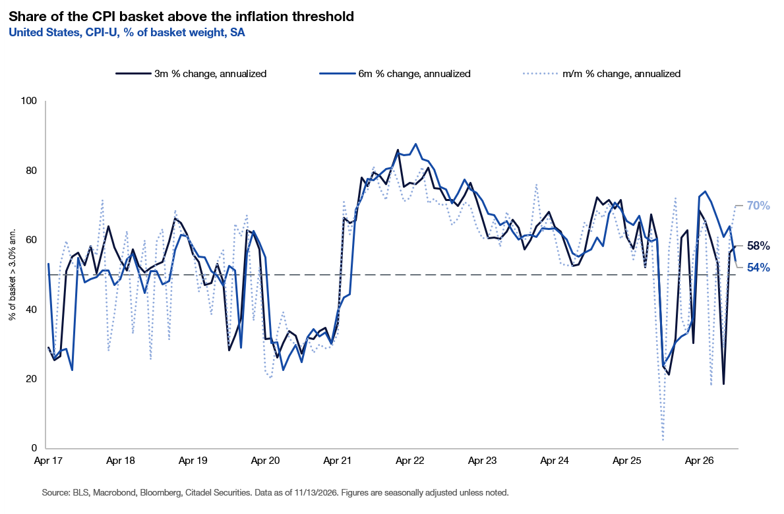
MEANWHILE, THE MACRO DATA CONTINUE TO GIVE THE FED REASONS TO TIGHTEN. Q3 real GDP grew 3.4% annualised, with private domestic final sales expanding 4.9%. October payrolls increased 165k, alongside 84k of upward revisions to the preceding two months, whilst average hourly earnings rose 0.4% MoM. Core CPI again increased 0.3%, failing to deliver the hoped-for moderation. Waller said a reading around 0.3% or higher would warrant considering a 50bp December hike. The wider Committee has yet to endorse a larger move, but this strengthens upside risks around further hikes. There is an important qualification…Q3 productivity increased 3.6% annualised, whilst unit labour costs fell 0.7%…encouraging evidence that supply capacity is improving alongside demand. The release does not establish how much is attributable to AI, but it reinforces why a sustained productivity acceleration would be so valuable. For now, resilient activity and persistent inflation leave financial conditions with more work to do…they remain comfortably easier than historical averages despite some tightening. As I have argued previously, the more tightening markets deliver, the less the Fed needs to do, and vice versa. Equity weakness alone provides limited grounds to expect monetary relief. My bullish US growth view and expectation of further hikes nevertheless depend on a resilient AI investment cycle. A controlled moderation in capex could improve discipline and allow revenues to catch up…but an investment stop would change the outlook for growth, earnings, and rates. I remain constructive on the deployment of intelligence, but political constraints, competition and higher financing costs make the timing of returns increasingly consequential.
MEANWHILE, THE MACRO DATA CONTINUE TO GIVE THE FED REASONS TO TIGHTEN. Q3 real GDP grew 3.4% annualised, with private domestic final sales expanding 4.9%. October payrolls increased 165k, alongside 84k of upward revisions to the preceding two months, whilst average hourly earnings rose 0.4% MoM. Core CPI again increased 0.3%, failing to deliver the hoped-for moderation. Waller said a reading around 0.3% or higher would warrant considering a 50bp December hike. The wider Committee has yet to endorse a larger move, but this strengthens upside risks around further hikes. There is an important qualification…Q3 productivity increased 3.6% annualised, whilst unit labour costs fell 0.7%…encouraging evidence that supply capacity is improving alongside demand. The release does not establish how much is attributable to AI, but it reinforces why a sustained productivity acceleration would be so valuable. For now, resilient activity and persistent inflation leave financial conditions with more work to do…they remain comfortably easier than historical averages despite some tightening. As I have argued previously, the more tightening markets deliver, the less the Fed needs to do, and vice versa. Equity weakness alone provides limited grounds to expect monetary relief. My bullish US growth view and expectation of further hikes nevertheless depend on a resilient AI investment cycle. A controlled moderation in capex could improve discipline and allow revenues to catch up…but an investment stop would change the outlook for growth, earnings, and rates. I remain constructive on the deployment of intelligence, but political constraints, competition and higher financing costs make the timing of returns increasingly consequential.
Legal Entities Disseminating this Material: This material is disseminated in the United Kingdom by Citadel Securities (Europe) Limited (“CSEL”) regulated by the Financial Conduct Authority (“FCA”) (Registered company number: 05462867); in the European Union by Citadel Securities GCS (Ireland) Limited (“CSGI”) and its Paris Branch regulated by the Central Bank of Ireland (“CBI”) (Registration Number: C173437); in Hong Kong by Citadel Securities (Hong Kong) Limited (“CDHK”) licensed by the Securities and Futures Commission of Hong Kong (“SFC”), in Japan by Citadel Securities Japan Co., Ltd (“CSJC”) registered as a Type 1 financial instruments business operator with the JFSA; and in the United States of America by Citadel Securities LLC (“CDRG”) registered with the Securities Exchange Commission (“SEC”) and Financial Industry Regulatory Authority (“FINRA”), Citadel Securities Institutional LLC (“CSIN”) registered with the SEC and FINRA or Citadel Securities Swap Dealer LLC (“CSSD”) registered with the SEC, Commodities Futures Trading Commission (“CFTC”), and National Futures Association (“NFA”). Unless governing law permits otherwise, you must contact a Citadel Securities entity in your home jurisdiction if you want to use our services in effecting a transaction in any financial instruments or securities, including derivatives.
FOR INSTITUTIONAL USE ONLY; FOR PROFESSIONAL CLIENTS AND ELIGIBLE COUNTERPARTIES ONLY. This material is not intended as and does not constitute investment research. Contents of this material will be strictly limited to non-specific, generic information (i.e. macro events/topics) and are not subject to the Markets in Financial Instruments directive (MiFID II) or FINRA research rules. This material does not constitute an offer, solicitation, invitation, or inducement to purchase, acquire, subscribe to, provide, or sell any financial instrument or otherwise engage in investment activity.
https://www.citadelsecurities.com/privacy/
Please see additional important disclosures, including disclosures that may be relevant to your country of residence or business at: https://www.citadelsecurities.com/disclosures/citadel-securities-fimm-sales-trading-disclosures/
Legal Entities Disseminating this Material: This material is disseminated in the United Kingdom by Citadel Securities (Europe) Limited (“CSEL”) regulated by the Financial Conduct Authority (“FCA”) (Registered company number: 05462867); in the European Union by Citadel Securities GCS (Ireland) Limited (“CSGI”) and its Paris Branch regulated by the Central Bank of Ireland (“CBI”) (Registration Number: C173437); in Hong Kong by Citadel Securities (Hong Kong) Limited (“CDHK”) licensed by the Securities and Futures Commission of Hong Kong (“SFC”), in Japan by Citadel Securities Japan Co., Ltd (“CSJC”) registered as a Type 1 financial instruments business operator with the JFSA; and in the United States of America by Citadel Securities LLC (“CDRG”) registered with the Securities Exchange Commission (“SEC”) and Financial Industry Regulatory Authority (“FINRA”), Citadel Securities Institutional LLC (“CSIN”) registered with the SEC and FINRA or Citadel Securities Swap Dealer LLC (“CSSD”) registered with the SEC, Commodities Futures Trading Commission (“CFTC”), and National Futures Association (“NFA”). Unless governing law permits otherwise, you must contact a Citadel Securities entity in your home jurisdiction if you want to use our services in effecting a transaction in any financial instruments or securities, including derivatives.
FOR INSTITUTIONAL USE ONLY; FOR PROFESSIONAL CLIENTS AND ELIGIBLE COUNTERPARTIES ONLY. This material is not intended as and does not constitute investment research. Contents of this material will be strictly limited to non-specific, generic information (i.e. macro events/topics) and are not subject to the Markets in Financial Instruments directive (MiFID II) or FINRA research rules. This material does not constitute an offer, solicitation, invitation, or inducement to purchase, acquire, subscribe to, provide, or sell any financial instrument or otherwise engage in investment activity.
https://www.citadelsecurities.com/privacy/
Please see additional important disclosures, including disclosures that may be relevant to your country of residence or business at: https://www.citadelsecurities.com/disclosures/citadel-securities-fimm-sales-trading-disclosures/


