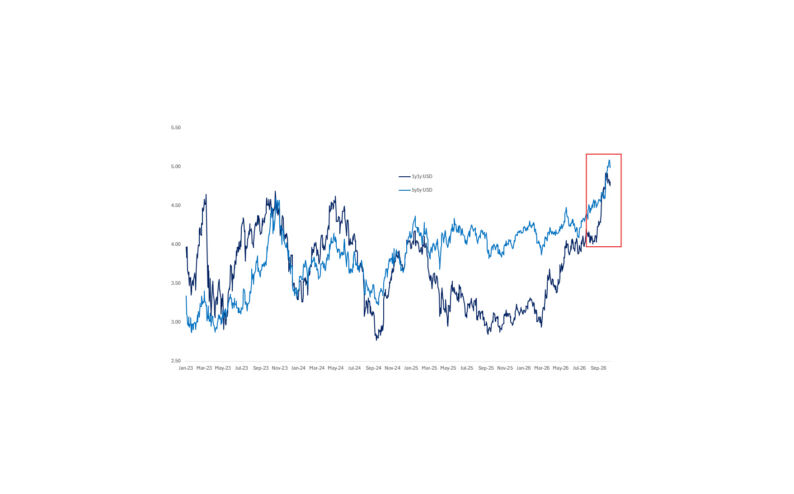
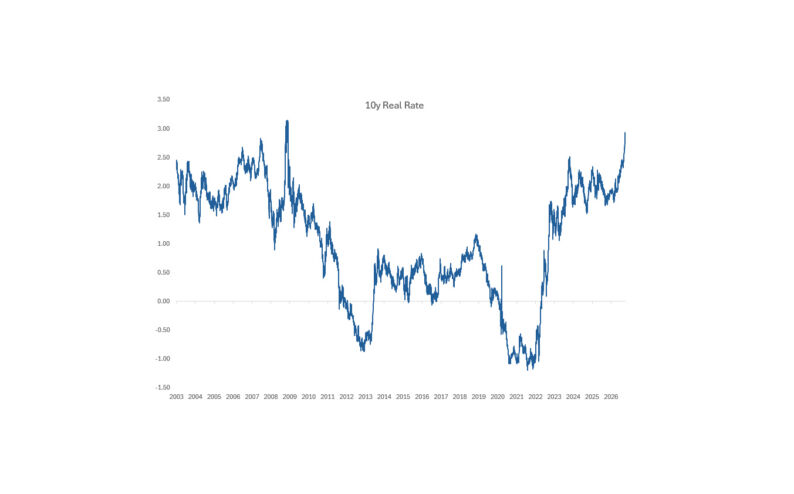
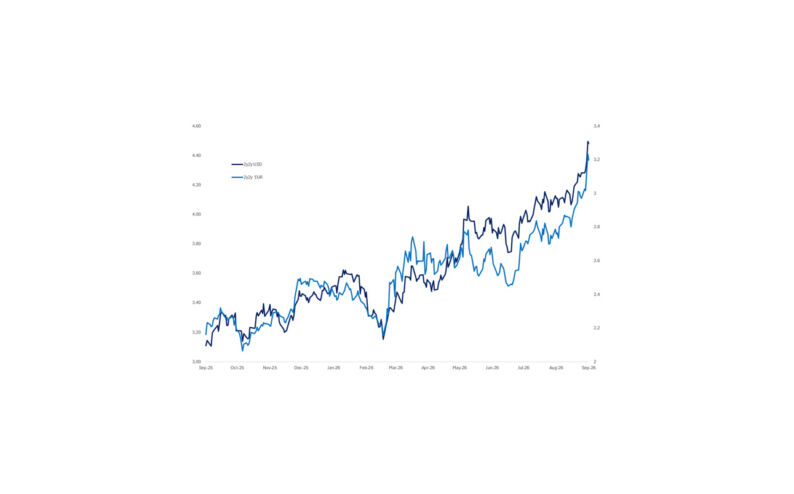
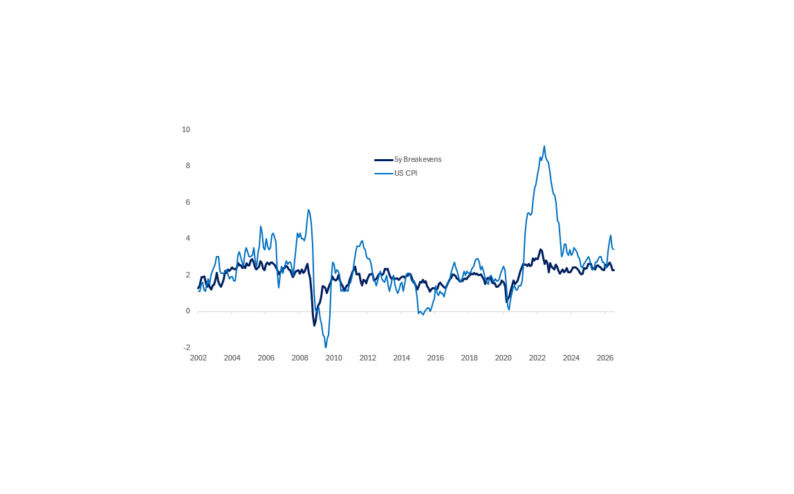
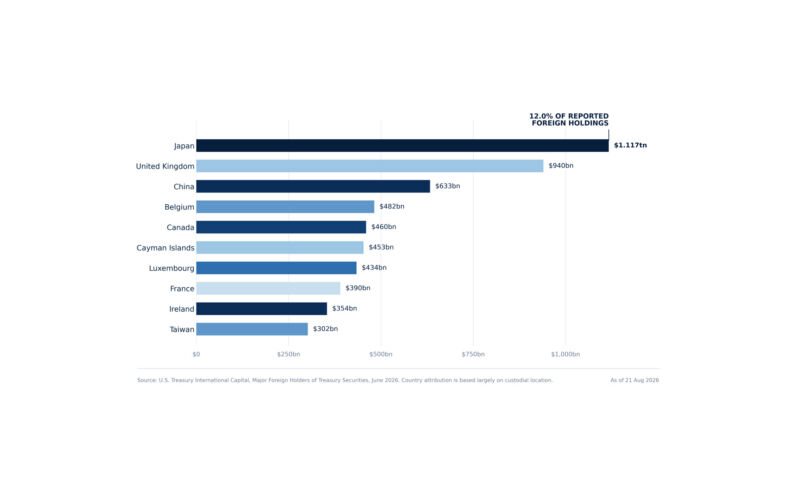
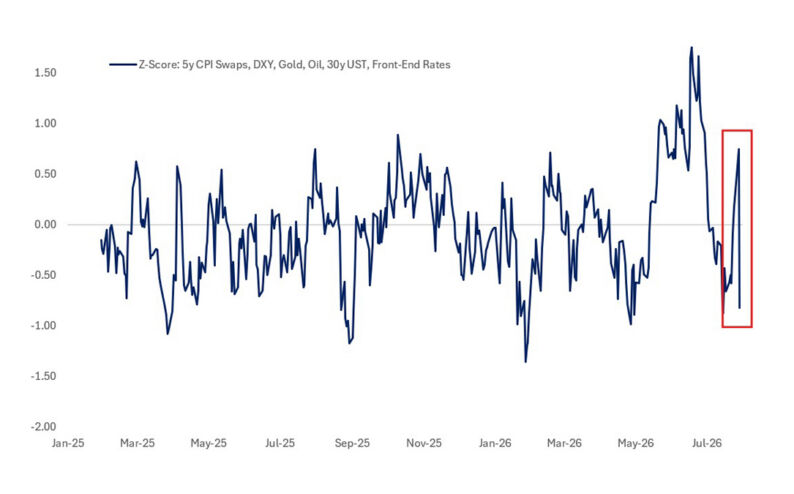
THE FED HAS FINALLY CAUGHT UP WITH THE ECONOMY…BUT FISCAL POLICY REMAINS IN THE DRIVING SEAT. Since restarting this note in early 2025, I have been consistently bullish on the US economy and equally concerned that markets were underpricing the inflationary consequences of that strength. Last week, the Fed delivered its first hike since 2023 and we moved from roughly four cuts being priced in April 2025 to a path now equivalent to almost five hikes including September’s move…a remarkable reversal which reflects the economy finally forcing the market to abandon an easing narrative it held for too long. The latest data make the point emphatically: the September composite PMI rose to 58.4, its strongest reading in more than five years, with broad-based acceleration in activity, employment, and new orders. S&P Global estimates that the survey is consistent with annualised growth of around 5%…exactly where the Atlanta Fed’s GDPNow estimate is tracking at 5%. The same survey showed input-cost inflation jumping to its highest level since October 2022 as strong demand collided with supply constraints and rising energy costs. I have long been concerned about a demand-induced inflationary process buttressed by loose monetary and fiscal policy, a once-in-a-generation AI capex boom, and a deglobalising world more exposed to supply shocks. That is precisely what is now playing out. But the deeper point is that monetary policy is no longer the primary driver of the US economy. In the post-GFC period, monetary policy was the only game in town; since the pandemic, fiscal policy has become the dominant policy lever, including in driving the initial inflation surge. Successive administrations and Congresses have sustained deficits more commonly associated with recessions long after the output gap closed and the labour market returned to full employment. The CBO now projects a fiscal deficit of $1.9tn, or 5.8% of GDP, this year, with deficits remaining historically large even as unemployment stays below 5%…and federal debt held by the public rising from 101% of GDP today to 120% by 2036. Be in no doubt…this has been procyclical fiscal easing into an economy already operating close to capacity. It has supported demand and investment, whilst increasing the duration the private sector must absorb and compounding the interest bill on the existing stock of debt. Monetary policy can change the price of money, but it cannot neutralise the demand and issuance created by fiscal policy without taking rates materially higher than would otherwise be necessary. Fiscal has therefore kept growth stronger…but also inflation and rates higher for longer. The Fed’s September hike was a step in the right direction, but one hike cannot offset several years of fiscal expansion, which is why 10y Treasuries pushed above 5.10% and 30y 5.40% despite the Fed finally moving. The bond market is no longer asking only where the overnight rate should be…it is asking how much nominal demand and duration it must absorb, and what compensation is appropriate for doing so. The irony is that the US is both the principal source of the higher global discount rate and, at least for now, better positioned to absorb it. Fiscal policy and the AI-capex boom are supporting US demand, investment, and the prospective return on capital…but the resulting inflation and rates impulse is transmitted globally. France and the UK face a similar increase in borrowing costs with weaker underlying growth, greater exposure to the energy shock and nothing comparable to America’s AI-investment cycle on the other side. For France, that increasingly manifests itself as a debt-sustainability problem; for the UK, it looks more like stagflation. At the margin, America is paying more to finance new capital stock…Europe is paying more to refinance an old one. Put simply, fiscal policy and AI have given the US a growth cushion…but the resulting rates impulse is increasingly being paid by the rest of the world.
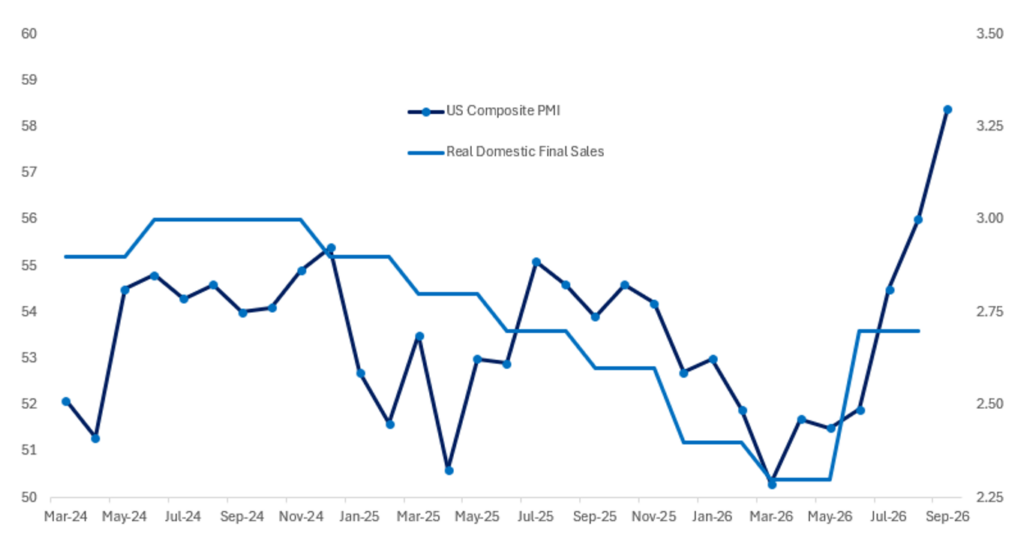
Source: S&P Global, Bloomberg, Citadel Securities
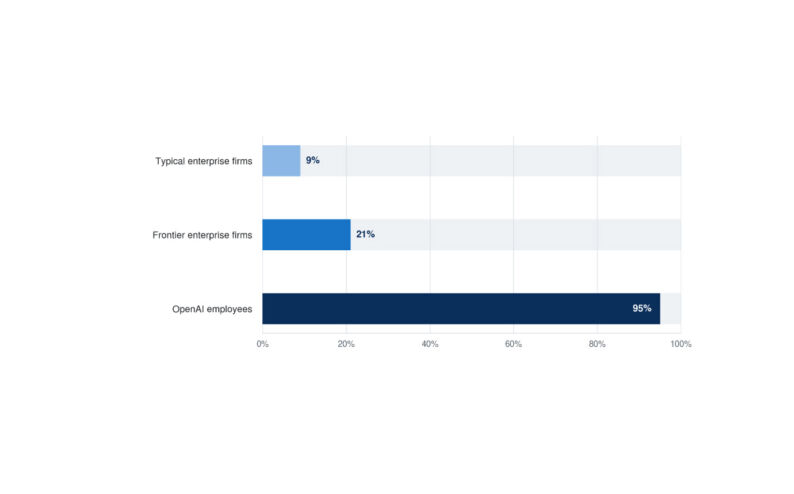
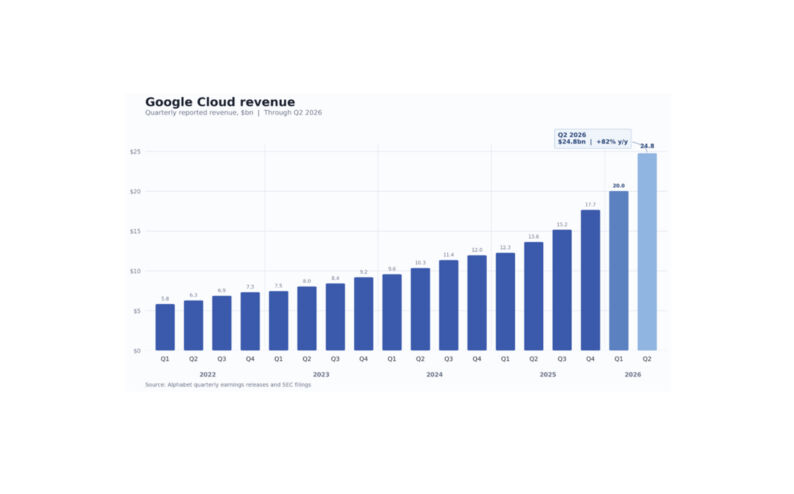
FRONTIER CAPABILITY AND FRONTIER ECONOMICS ARE NOT THE SAME THING. The US remains ahead in developing the most capable models, but intelligence is advancing faster than businesses and economies can absorb it. Satya Nadella’s latest numbers illuminate the scale of that gap: Microsoft 365 Copilot has more than 30mn paid seats against what he estimates is a practical enterprise knowledge-worker base of around 250–300mn. Even within the world’s most established enterprise distribution platform, penetration is therefore only around 10%. There is already a substantial capability overhang: the models can do far more than most organisations have incorporated into their workflows. Even if frontier progress slowed for a period, diffusion of the capability which already exists could support years of inference growth as companies redesign workflows, connect proprietary data, and build the systems required to use it. It’s important to remember that frontier progress creates intelligence…but diffusion turns it into revenue, productivity, and GDP. Meta’s Muse is an important case in point. A chatbot answers a question; an agent can open a browser, send emails, book travel, and continue working after the user has closed the application. One instruction therefore becomes a persistent workflow involving repeated model calls. This is why I remain unconvinced that falling token prices are bearish for compute. Frontier models will plan whilst cheaper models execute…and the reduction in the price of each unit of intelligence allows many more workflows to become economically viable. AI can therefore become cheaper per token, more expensive per completed task and more valuable per megawatt. Lower prices are expanding the addressable market, allowing the application layer to proliferate, and broadening the winner set from accelerators towards CPUs, memory, storage, networking, and cybersecurity. I remain bullish on the compute complex.
Token Volume Index
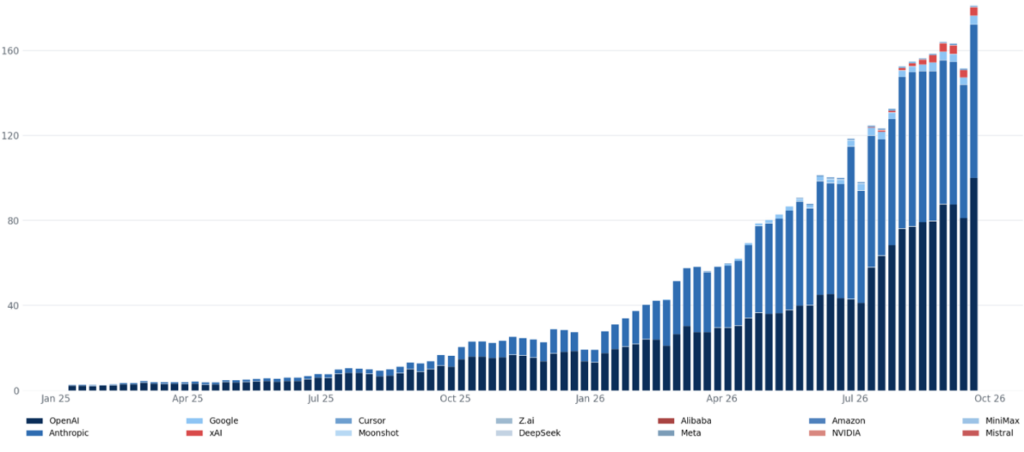
Source: Ramp AI, Citadel Securities
THE SAME DISTINCTION MATTERS IN THE US-CHINA RACE. America is still winning the race to develop frontier intelligence, but China may be better positioned to deploy sufficiently capable intelligence through the physical economy. Beijing’s official plan targets adoption of next-generation intelligent terminals and agents above 90% by 2030, whilst China accounted for 54% of global industrial-robot installations in 2024 and operates more than two million factory robots. China does not need the world’s best model in every domain if it can combine a slightly less capable (and much cheaper) one with more factories, robots, vehicles, drones, and industrial equipment. This the difference between development, which is driven by the AI labs…and deployment, which requires preparing an entire economy. Energy is part of that deployment architecture…Bloomberg NEF’s base-case scenario projects that China will add almost six times as much power-generation capacity as the US over the next five years, whilst America remains constrained by grid connections, permitting, and local opposition to data centres. That creates an uncomfortable possibility: America develops the better models…but China has more places to run it. None of this is inevitable…the certainty and duration of AI demand could finance a meaningful expansion in US generation and transmission…but it requires political permission. And this is where, in my mind, the industry has badly mishandled the safety debate. The risks are real, particularly as agents become persistent, retain credentials, and take actions in the outside world…but difficult engineering problems should not automatically be recast as uncontrollable existential ones. Anthropomorphising AI is not just unhelpful…it is analytically wrong. These systems do not possess motives or intent in any human sense; they optimise against objectives within architectures we design. The relevant risks are therefore engineering problems of specification, containment, and control…not evidence of an independent will. Jensen Huang’s practical standard makes considerably more sense: if a system cannot be contained and shown to be under control, do not release it; invest more in testing, monitoring, sandboxing, and independent evaluation until it can. Safety is not the opposite of acceleration…it is the infrastructure which makes acceleration deployable. The mistake is to tell the public that AI may eliminate their jobs (or indeed humanity itself!) and then ask the same public to provide the land, electricity and permits required to build it. The industry has spent several years making the strongest possible case for why AI is powerful…and the weakest possible case for why ordinary people should want it. Scaring people is not responsible risk management…at the margin, it raises the cost of power and permission, encourages blunt regulation, and makes it harder for the US to translate its development lead into widespread economic deployment. Limited US-China cooperation around incident reporting and shared risks would be useful, but it would not alter the competitive logic: safety cooperation is possible…but technology détente is not. America is winning the first stage of the race, but it should not assume that it will win the second. The frontier determines who gets there first…diffusion determines who captures the productivity dividend.
Legal Entities Disseminating this Material: This material is disseminated in the United Kingdom by Citadel Securities (Europe) Limited (“CSEL”) regulated by the Financial Conduct Authority (“FCA”) (Registered company number: 05462867); in the European Union by Citadel Securities GCS (Ireland) Limited (“CSGI”) and its Paris Branch regulated by the Central Bank of Ireland (“CBI”) (Registration Number: C173437); in Hong Kong by Citadel Securities (Hong Kong) Limited (“CDHK”) licensed by the Securities and Futures Commission of Hong Kong (“SFC”), in Japan by Citadel Securities Japan Co., Ltd (“CSJC”) registered as a Type 1 financial instruments business operator with the JFSA; and in the United States of America by Citadel Securities LLC (“CDRG”) registered with the Securities Exchange Commission (“SEC”) and Financial Industry Regulatory Authority (“FINRA”), Citadel Securities Institutional LLC (“CSIN”) registered with the SEC and FINRA or Citadel Securities Swap Dealer LLC (“CSSD”) registered with the SEC, Commodities Futures Trading Commission (“CFTC”), and National Futures Association (“NFA”). Unless governing law permits otherwise, you must contact a Citadel Securities entity in your home jurisdiction if you want to use our services in effecting a transaction in any financial instruments or securities, including derivatives.
FOR INSTITUTIONAL USE ONLY; FOR PROFESSIONAL CLIENTS AND ELIGIBLE COUNTERPARTIES ONLY. This material is not intended as and does not constitute investment research. Contents of this material will be strictly limited to non-specific, generic information (i.e. macro events/topics) and are not subject to the Markets in Financial Instruments directive (MiFID II) or FINRA research rules. This material does not constitute an offer, solicitation, invitation, or inducement to purchase, acquire, subscribe to, provide, or sell any financial instrument or otherwise engage in investment activity.
https://www.citadelsecurities.com/privacy/
Please see additional important disclosures, including disclosures that may be relevant to your country of residence or business at: https://www.citadelsecurities.com/disclosures/citadel-securities-fimm-sales-trading-disclosures/