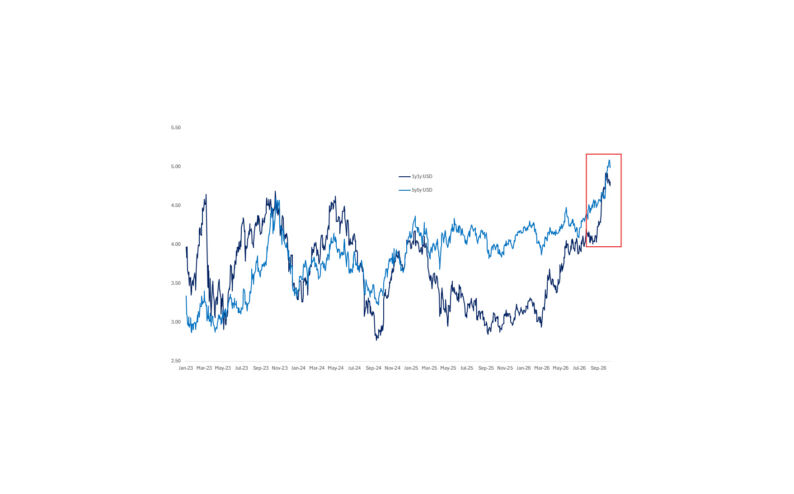
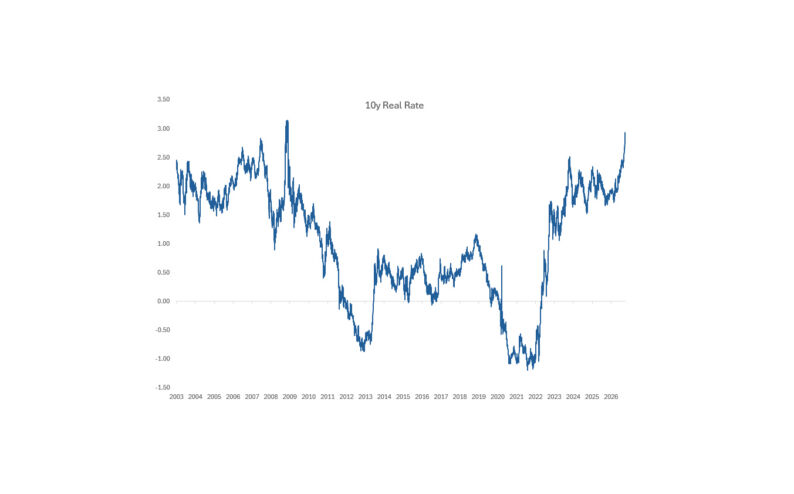
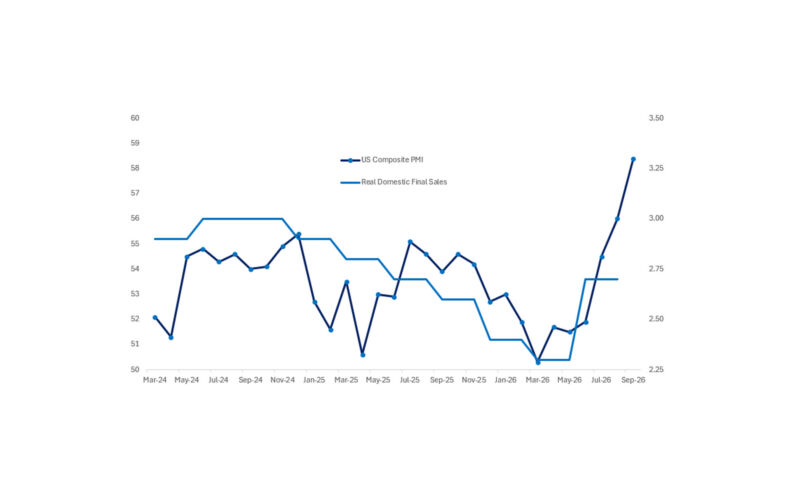
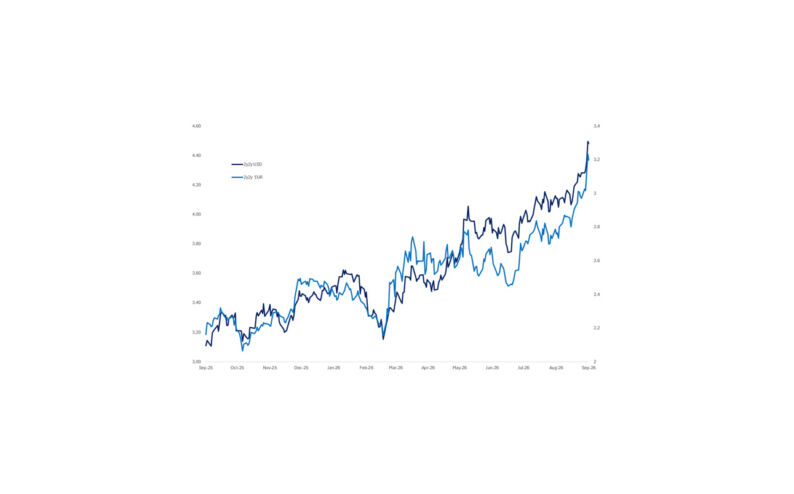
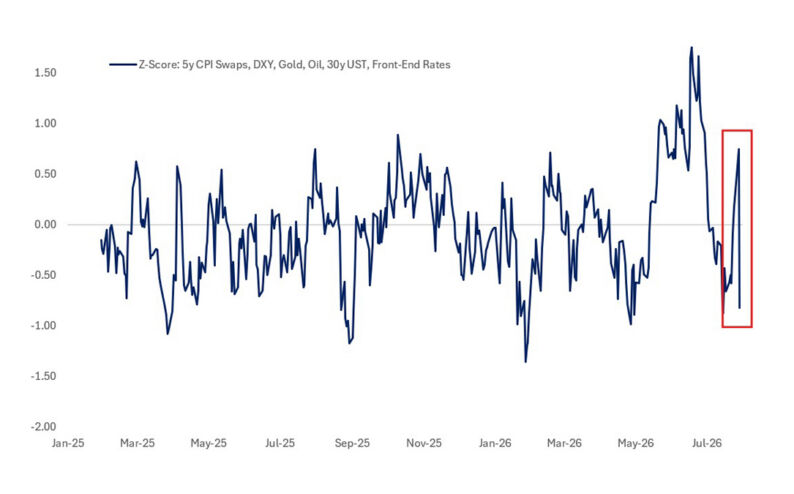
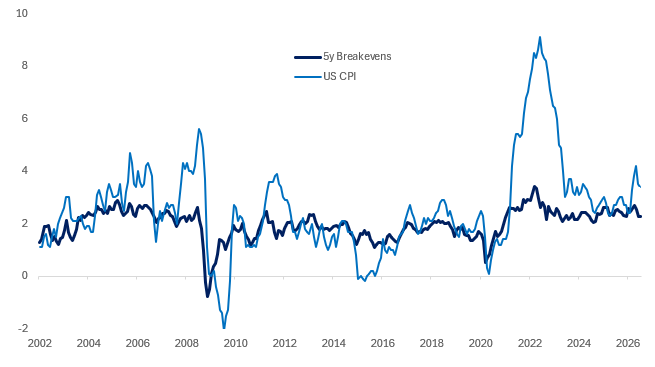
CHAIR WARSH HAS NARROWED THE CASE FOR WAITING…without fully committing to a hike. In July, the Chair argued that higher nominal and real Treasury yields had allowed markets to do some of the Fed’s tightening for it…but at Jackson Hole, he said the economy has strengthened, the labour market is consistent with full employment and broad financial conditions are not restrictive. More importantly, whilst acknowledging that this summer’s PCE and CPI readings were better than expected, Warsh said they did not show that underlying inflation trends had “meaningfully improved”. His standard is that the Fed must be confident inflation is moving towards 2% both clearly and “at sufficient speed”…otherwise, “we have work to do”. The latter is sufficiently subjective to preserve some optionality (sufficient speed does not have to be September), but the direction of travel is nevertheless more hawkish than one might previously have assumed. Warsh also dismissed moderate wage growth as a reliable leading indicator of inflation and instead focused on the breadth of price increases across the 199 components of PCE. Some 54% have risen by more than 3% over the past year, down from the post-pandemic peak of around 77% but still well above the pre-pandemic average of 32%…over the past six months, the equivalent share remains 49%. The choice to emphasise both six- and twelve-month breadth suggests he is looking through the better recent prints rather than treating them as sufficient evidence of disinflation. Equally notable was what he did not say…there was much less criticism of measured inflation, no discussion of what the inflation task force might conclude in January, and an unequivocal reaffirmation that 2% PCE is the firm and fixed target. In my mind, this is materially more hawkish than July because the market tightening that previously provided comfort is no longer judged sufficient, whilst neither softer wages nor a handful of better inflation prints meet the test he has now established. He avoided an explicit signal for September (in keeping with no forward guidance)…but absent a meaningful miss in the data, the burden of proof increasingly appears to favour a hike. Holding again would leave the gap between the Fed’s rhetoric and delivery increasingly difficult to reconcile.
Source: Bloomberg, Citadel Securities
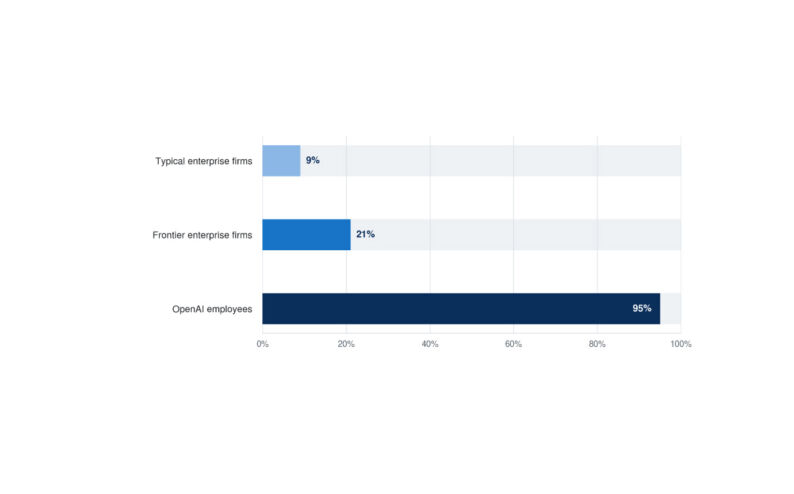
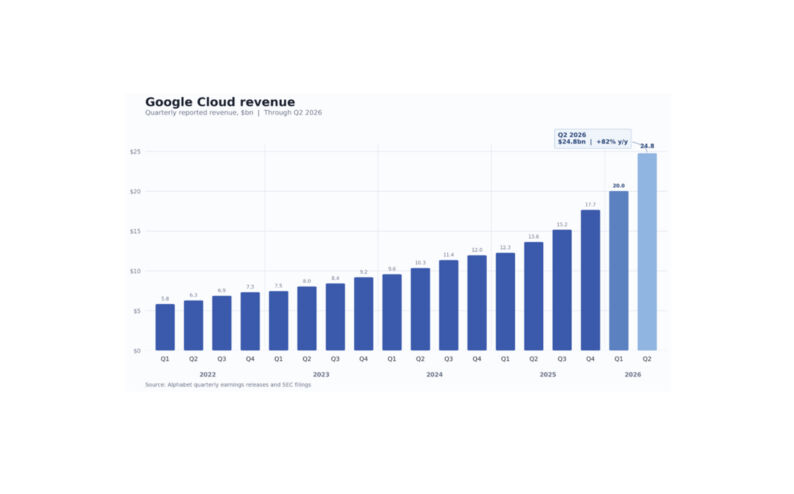
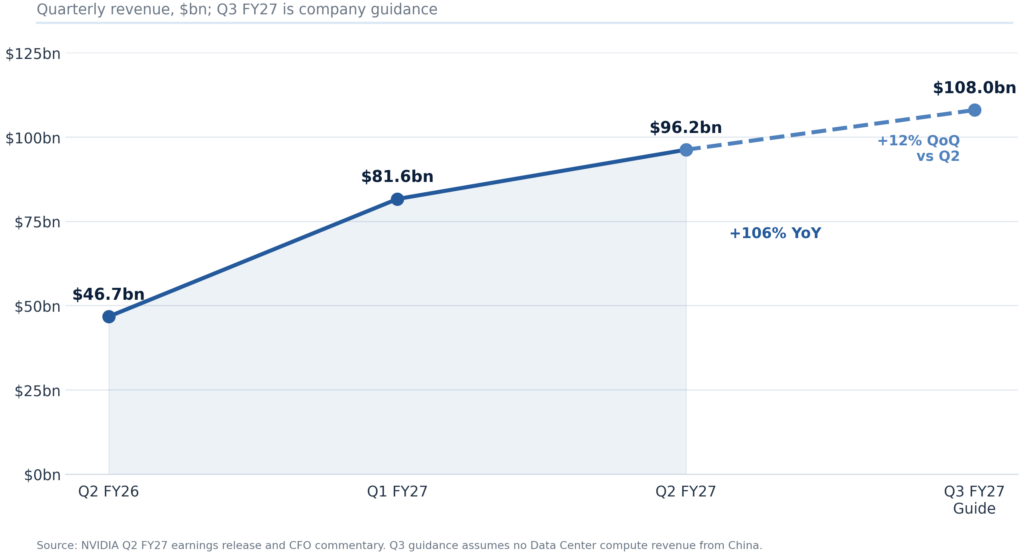
COMPUTE DEMAND IS STRONG. Nvidia’s latest earnings provide perhaps the clearest near-term evidence of this dynamic after a turbulent summer for macro markets and the broader AI narrative. Revenue reached $96.2bn (+18% QoQ, +106% YoY), including $89bn from data centres (+117% YoY), with Q3 revenue guidance of $108bn. However, the most salient element of the call was management’s indication that revenue could grow by ~70% in FY28, versus roughly 45% embedded in consensus…an unusually early but meaningful upgrade to the medium-term demand picture. That visibility pushes back against concerns that AI infrastructure is being overbuilt, or that some combination of more efficient models and overly optimistic expectations will ultimately undermine the ecosystem. Importantly, Jensen framed the outlook as supply-constrained, saying that unconstrained demand would be “a lot higher” and that Nvidia simply cannot secure enough memory, wafers, power, and data centre capacity to fulfil the potential orderbook. Given he is the CEO with probably the most complete information-set in the world on this topic, I am taking him at his word. The demand base is also broadening with hyperscaler revenue rising 13% sequentially to ~$49bn, whilst AI cloud, industrial and enterprise revenue increased 25% to ~$40bn, reducing dependence on only a handful of very large customers. This chimes with Frank Flight’s work highlighting the more constructive evidence on overall AI spending and compute demand despite lower token prices. A recent podcast with Dylan Patel of SemiAnalysis, one of the best analysts of the AI supply chain, puts even more striking numbers around the longer-term dynamic. Patel estimates that the world will add around 30GW of AI compute in 2026, 50GW in 2027 and 70GW in 2028; SemiAnalysis models more than $11tn of cumulative AI capex between 2024 and 2029…and still believes that will leave supply short of the demand implied by model and revenue growth. Crucially, this is no longer just speculative spending in anticipation of future revenues. Estimates suggest that compute costing $10–15mio per MW can already generate as much as $50mio of revenue per MW at Anthropic. This alters the dynamic…inference generates cash, that cash is recycled into training and research…and better models generate more revenue per MW. OpenAI began the year at ~2GW and Anthropic at less than 2GW, but both are expected to finish above 5GW. Demand for compute then becomes self-reinforcing. Moreover, the hyperscalers own the balance sheets and much of the physical infrastructure, whilst the leading frontier labs increasingly own the highest-return (though with greater variance) use of that infrastructure. The read-through therefore remains supportive of the broader AI-infrastructure layer including cloud, memory, networking, and power…without implying that every company spending at the frontier will earn attractive returns. Nor is efficiency likely to provide much of a release valve. The newest systems deliver roughly 3–5x more performance per watt than the prior generation, but that simply raises the economic return to deploying them and expands the range of viable workloads. In essence, better models and cheaper inference do not reduce the need for compute…they increase the value of consuming it. The binding constraints are increasingly memory, wafers, power, permitting, and capital.
MY TAKEAWAY FOR MARKETS IS BULLISH EQUITIES. The fundamental evidence around AI has improved whilst the macro backdrop remains supportive, characterised by easy financial conditions and renewed confidence in the durability of the AI capex cycle. That combination should provide a favourable backdrop for US risk assets into the midterms, and likely a renewed leg higher in the AI-infrastructure complex after a difficult summer. This will now likely be supported by a stabilisation in long-end yields following Chair Warsh’s speech…as I highlighted in an earlier note, a more hawkish policy stance is crucial to stabilising term premium in long-end yields, which in turn are fundamental to the AI story as much as the risk-asset complex more broadly. That said, I see this as a window for optimism rather than an open-ended trend, as the midterms will bring into focus the distributional questions and the politics of AI infrastructure, particularly power, permitting and the concentration of economic rents – topics I have been writing about extensively. For now, the fundamental evidence argues for leaning into the window rather than looking through it, whilst recognising that the window probably becomes considerably foggier as November approaches.
Legal Entities Disseminating this Material: This material is disseminated in the United Kingdom by Citadel Securities (Europe) Limited (“CSEL”) regulated by the Financial Conduct Authority (“FCA”) (Registered company number: 05462867); in the European Union by Citadel Securities GCS (Ireland) Limited (“CSGI”) and its Paris Branch regulated by the Central Bank of Ireland (“CBI”) (Registration Number: C173437); in Hong Kong by Citadel Securities (Hong Kong) Limited (“CDHK”) licensed by the Securities and Futures Commission of Hong Kong (“SFC”), in Japan by Citadel Securities Japan Co., Ltd (“CSJC”) registered as a Type 1 financial instruments business operator with the JFSA; and in the United States of America by Citadel Securities LLC (“CDRG”) registered with the Securities Exchange Commission (“SEC”) and Financial Industry Regulatory Authority (“FINRA”), Citadel Securities Institutional LLC (“CSIN”) registered with the SEC and FINRA or Citadel Securities Swap Dealer LLC (“CSSD”) registered with the SEC, Commodities Futures Trading Commission (“CFTC”), and National Futures Association (“NFA”). Unless governing law permits otherwise, you must contact a Citadel Securities entity in your home jurisdiction if you want to use our services in effecting a transaction in any financial instruments or securities, including derivatives.
FOR INSTITUTIONAL USE ONLY; FOR PROFESSIONAL CLIENTS AND ELIGIBLE COUNTERPARTIES ONLY. This material is not intended as and does not constitute investment research. Contents of this material will be strictly limited to non-specific, generic information (i.e. macro events/topics) and are not subject to the Markets in Financial Instruments directive (MiFID II) or FINRA research rules. This material does not constitute an offer, solicitation, invitation, or inducement to purchase, acquire, subscribe to, provide, or sell any financial instrument or otherwise engage in investment activity.
https://www.citadelsecurities.com/privacy/
Please see additional important disclosures, including disclosures that may be relevant to your country of residence or business at: https://www.citadelsecurities.com/disclosures/citadel-securities-fimm-sales-trading-disclosures/