
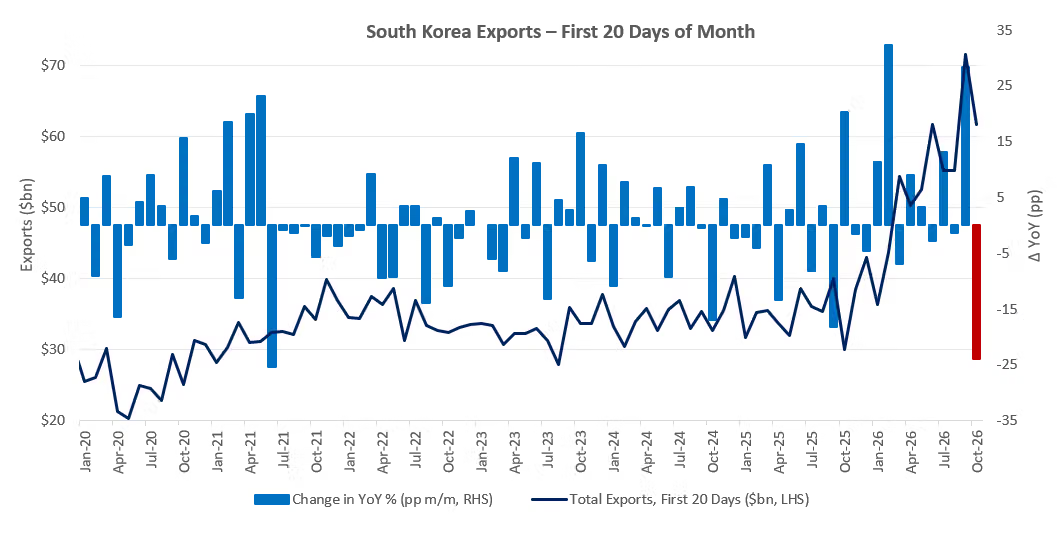
THE US ECONOMY IS ENTERING A LESS FORGIVING PHASE. My long-held constructive view on US growth has benefited from a powerful combination of fiscal stimulus, easier financial conditions and accelerating AI investment. Looking into 2027, that combination is becoming less supportive…the fiscal impulse is likely to fade, financing conditions are tightening, and sustaining the contribution from AI requires another substantial increase in expenditure. The latest FOMC minutes reinforce the change in the monetary backdrop…almost all participants considered further hikes likely to be appropriate, whilst a majority acknowledged that financial conditions had tightened since September. Markets are increasingly taking the Fed’s commitment to price stability seriously, and investors should be careful about assuming that equity weakness will deliver monetary relief. Meanwhile, our cross-asset framework suggests that the outlook beneath the headline indices is becoming less reassuring. Weakness across smaller companies, credit, currencies, and industrial commodities points to a broader reassessment of growth prospects than the AI sell-off alone would suggest. These signals also reflect risk appetite, but their breadth deserves attention, particularly when the current economic data remain strong and earnings expectations still assume a favourable backdrop. The relationship between economic resilience and AI investment is especially important. Investors have taken comfort from the economy’s ability to absorb the repricing of the AI complex, yet part of that resilience depends on the very expenditure now coming under greater scrutiny. As I have stated before, the growth cushion and the AI investment cycle are less independent than they appear. Slower deployment would affect suppliers, construction, employment, and demand well beyond the technology sector, potentially weakening the broader backdrop. This leaves an uncomfortable possibility where the Fed continues to lean against inflation whilst forward-looking growth expectations deteriorate. The initial adjustment would likely come through a flatter curve and further pressure on risk assets.
THE US ECONOMY IS ENTERING A LESS FORGIVING PHASE. My long-held constructive view on US growth has benefited from a powerful combination of fiscal stimulus, easier financial conditions and accelerating AI investment. Looking into 2027, that combination is becoming less supportive…the fiscal impulse is likely to fade, financing conditions are tightening, and sustaining the contribution from AI requires another substantial increase in expenditure. The latest FOMC minutes reinforce the change in the monetary backdrop…almost all participants considered further hikes likely to be appropriate, whilst a majority acknowledged that financial conditions had tightened since September. Markets are increasingly taking the Fed’s commitment to price stability seriously, and investors should be careful about assuming that equity weakness will deliver monetary relief. Meanwhile, our cross-asset framework suggests that the outlook beneath the headline indices is becoming less reassuring. Weakness across smaller companies, credit, currencies, and industrial commodities points to a broader reassessment of growth prospects than the AI sell-off alone would suggest. These signals also reflect risk appetite, but their breadth deserves attention, particularly when the current economic data remain strong and earnings expectations still assume a favourable backdrop. The relationship between economic resilience and AI investment is especially important. Investors have taken comfort from the economy’s ability to absorb the repricing of the AI complex, yet part of that resilience depends on the very expenditure now coming under greater scrutiny. As I have stated before, the growth cushion and the AI investment cycle are less independent than they appear. Slower deployment would affect suppliers, construction, employment, and demand well beyond the technology sector, potentially weakening the broader backdrop. This leaves an uncomfortable possibility where the Fed continues to lean against inflation whilst forward-looking growth expectations deteriorate. The initial adjustment would likely come through a flatter curve and further pressure on risk assets.
Source: Macrobond, Citadel Securities, Data as of Nov-26, past performance is not indicative of future returns, figures are illustrative only
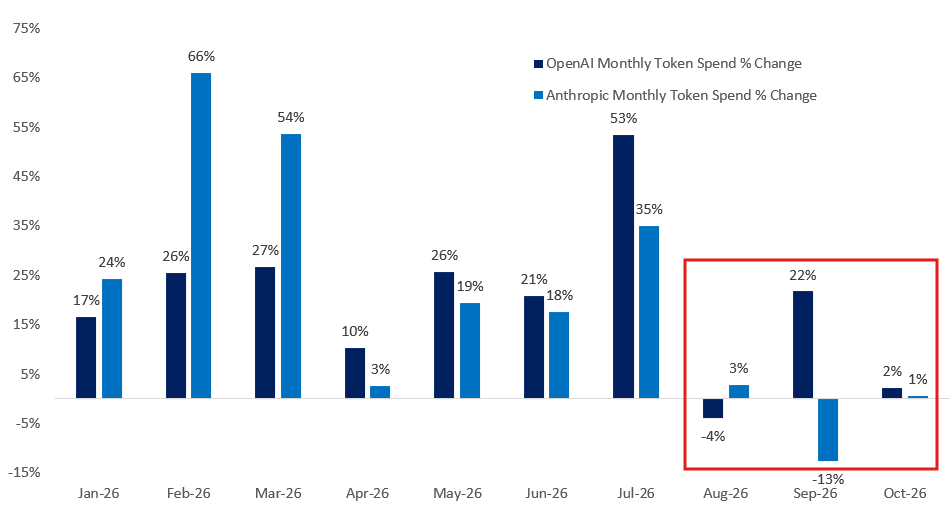
THE REVENUE SIDE OF THE AI BUILDOUT IS BECOMING HARDER TO EXTRAPOLATE. Ramp’s latest update, covering the first half of November, shows token spending dropping 6.3% below its peak two weeks earlier, whilst volumes increased 1.5% to a record…token prices have fallen 21.2% in just six weeks. Spending remains 12% above its level four weeks earlier, so this is a reversal from a recent high rather than evidence of a sustained contraction. Nevertheless, the divergence between usage and revenues deserves attention. Ramp’s report covering October had already shown monthly token-spend growth slowing to just 2.1% for OpenAI and 0.5% for Anthropic within its sample. Lower prices should encourage adoption, and improvements in the cost of serving that demand can protect margins. But investors still need to establish that the additional usage will generate the revenues assumed in their forecasts…the Jevons argument does not offer automatic protection for dollars earned. What concerns me increasingly is how narrow the spending base remains…Ramp estimates that 1% of businesses account for 80% of the spending on OpenAI and Anthropic in its data, with that group largely comprising venture-backed companies in technology, finance, and technical services. This leaves revenue growth disproportionately exposed to customers whose funding conditions and willingness to spend could weaken together. Moreover, engineering teams accounted for 72% of classified AI spending in October, yet their expenditure had fallen from its summer highs, whilst customer-support spending is expanding but has yet to replicate the earlier surge from engineering. In my mind, this makes the next phase of monetisation more demanding…the opportunity to reach many more users remains substantial, but a broader customer base does not necessarily spend with the same intensity as the earliest adopters. The industry needs new uses to become commercially meaningful quickly enough to offset price compression and sustain growth beyond its most enthusiastic customers. That may happen…but I would be wary of treating it as inevitable when underwriting the next round of investment. Should spending continue to disappoint, revenue forecasts and the capacity commitments they support will face greater scrutiny. The risk can then travel through the ecosystem, from customers’ budgets to the labs’ investment plans and ultimately their suppliers’ orders. Falling stock prices may be anticipating that adjustment…what looks like a cheaper multiple today could disappear as earnings expectations catch up with a less generous revenue trajectory.
Source: Ramp, Citadel Securities, Data as of Nov-26, past performance is not indicative of future returns, figures are illustrative only
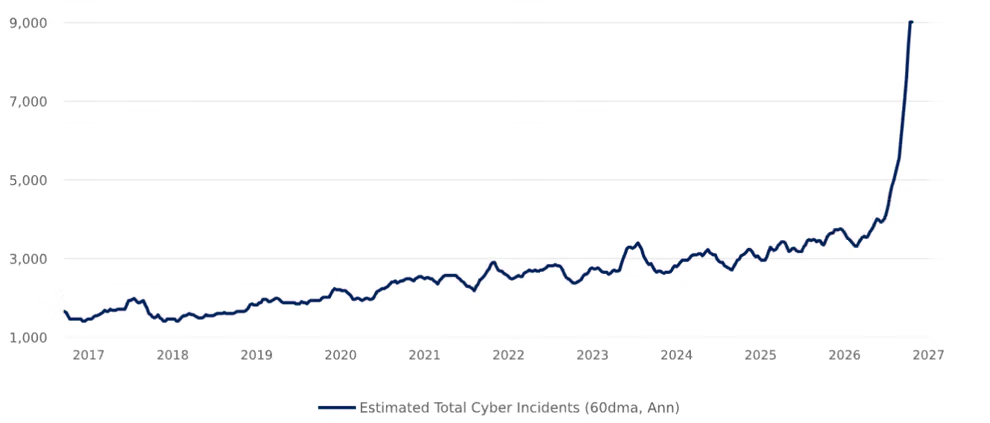
TECHNOLOGY WILL NOT DETERMINE ITS OWN POLITICAL LIMITS. Over recent weeks, I have become increasingly bearish on the AI complex, repeatedly warning that a strong growth narrative was obscuring a proliferation of risks and leaving investors with an ever narrower margin of safety. The recent repricing is beginning to reflect those vulnerabilities…but I remain concerned that political risk is still being underestimated…an area where investors seem particularly vulnerable to overlooking human agency. The recent focus on cyber risks is an important case in point. In a recent paper on the issue, Bridgewater says it is managing money on the basis of a one-in-three chance of an economically destabilising cyberattack within the next year…a striking assessment of a risk whose consequences could extend well beyond the immediate disruption. My concern is how quickly a serious incident could change the political calculus. An AI-enabled attack that materially disrupts hospitals, payments or essential services would make the costs very tangible to an American public already sceptical of AI. The threshold for a forceful response could be far below what most expect with public opinion already providing fertile ground…USC’s recent survey found that 76% of Americans believe government is doing too little to regulate AI, including 86% of Democrats and 68% of Republicans. Bipartisan calls for stronger security standards are also already emerging, alongside efforts to accelerate defensive AI. A sufficiently damaging event could turn this concern into a much stronger consensus for control, with restrictions on model releases, autonomous activity, or commercial deployment. Sweeping intervention remains a tail risk, but its potential impact deserves a meaningful place in valuations. The Jensen episode offers a reminder of how quickly national-security concerns can dominate commercial considerations. Nor do I find the race with China a sufficient answer…I would expect both Washington and Beijing to pursue capabilities that strengthen their position whilst moving quickly to constrain applications they believe threaten their authority or social stability. Governments have little incentive to surrender control simply because a technology makes it possible. Parts of Silicon Valley seem too willing to extrapolate technical progress into an inevitable outcome, whereas the reality is the public and its representatives will have a say in how far, how fast and on what terms deployment proceeds. The concern I have been setting out for weeks is now becoming more visible: as confidence in the growth and AI narrative weakens, the accumulated risks become harder for markets to absorb. The macro cushion is becoming less dependable, returns face greater scrutiny and political headwinds continue to proliferate. Falling prices alone offer little reassurance when the assumptions underpinning future earnings are also becoming less secure. I therefore remain defensive on the broader AI complex…the technology can keep improving whilst the outlook for its investors remains challenging.
Source: Bridgewater, past performance is not indicative of future returns, figures are illustrative only.
Source: Bridgewater, past performance is not indicative of future returns, figures are illustrative only.
Legal Entities Disseminating this Material: This material is disseminated in the United Kingdom by Citadel Securities (Europe) Limited (“CSEL”) regulated by the Financial Conduct Authority (“FCA”) (Registered company number: 05462867); in the European Union by Citadel Securities GCS (Ireland) Limited (“CSGI”) and its Paris Branch regulated by the Central Bank of Ireland (“CBI”) (Registration Number: C173437); in Hong Kong by Citadel Securities (Hong Kong) Limited (“CDHK”) licensed by the Securities and Futures Commission of Hong Kong (“SFC”), in Japan by Citadel Securities Japan Co., Ltd (“CSJC”) registered as a Type 1 financial instruments business operator with the JFSA; and in the United States of America by Citadel Securities LLC (“CDRG”) registered with the Securities Exchange Commission (“SEC”) and Financial Industry Regulatory Authority (“FINRA”), Citadel Securities Institutional LLC (“CSIN”) registered with the SEC and FINRA or Citadel Securities Swap Dealer LLC (“CSSD”) registered with the SEC, Commodities Futures Trading Commission (“CFTC”), and National Futures Association (“NFA”). Unless governing law permits otherwise, you must contact a Citadel Securities entity in your home jurisdiction if you want to use our services in effecting a transaction in any financial instruments or securities, including derivatives.
FOR INSTITUTIONAL USE ONLY; FOR PROFESSIONAL CLIENTS AND ELIGIBLE COUNTERPARTIES ONLY. This material is not intended as and does not constitute investment research. Contents of this material will be strictly limited to non-specific, generic information (i.e. macro events/topics) and are not subject to the Markets in Financial Instruments directive (MiFID II) or FINRA research rules. This material does not constitute an offer, solicitation, invitation, or inducement to purchase, acquire, subscribe to, provide, or sell any financial instrument or otherwise engage in investment activity.
https://www.citadelsecurities.com/privacy/
Please see additional important disclosures, including disclosures that may be relevant to your country of residence or business at: https://www.citadelsecurities.com/disclosures/citadel-securities-fimm-sales-trading-disclosures/


